Official product information
Lymph Savior Benefits: What Is Claimed, and What Is Evidenced
One support claim on the front of the bottle, the FDA rules it is written under, and what the federal fact sheets hold for each of the eleven botanicals on its label.
Written by the Lymph Savior Editorial Desk · Medical review: Dr. Carrie Lam, MD, Physician · Revised · Editorial standards
Quick answer
Lymph Savior makes one claim: Advanced Lymphatic Health Support. It is a structure/function claim, it names no disease, and the FDA disclaimer is printed on the label and repeated on three marketing images — which is the row this product scores best on. No federal page this site reads supports a botanical supplement for lymphatic health. The label prints an amount for each of its eleven botanicals, in mcg, and no trial of the formula has been published.
1 claim, five words
The single claim on the bottle
Advanced Lymphatic Health Support, and one marketing line beside it. That is the whole of it.
There is exactly one claim on the front of this bottle: Advanced Lymphatic Health Support. The sales material adds one line beside it — Move freely through each day with Lymph Savior! — and that is the whole of what this product says it does. No second claim, no bullet list of benefits.
Read the front of this bottle and count what is on it. A brand name. One support claim. A count. The words dietary supplement. A roundel that combines a country of manufacture, a sourcing caveat and a serving count in one mark. That is five pieces of information, and none of them is an ingredient amount. The eleven botanicals and their amounts sit on the Supplement Facts panel, not on the front; the order page shows only the front, so the panel is worth checking on the bottle you receive.
1
1
0
3
11
6.5 / 10
01 support, not treat
The rules a supplement claim is written under
What FDA permits, what it forbids, and what a permitted claim does not mean.
Supplement claims are not a free-for-all, and the rule explains why this label reads the way it does.
What a structure/function claim is
A structure/function claim, in FDA’s wording, may “describe the role of a nutrient or dietary ingredient intended to affect the normal structure or function of the human body”. FDA’s own examples are “calcium builds strong bones” and “fiber maintains bowel regularity”.
Where the line is
A disease claim is different in kind. FDA states that “a product sold as a dietary supplement and represented explicitly or implicitly for treatment, prevention, or cure of a specific disease or class of diseases meets the definition of a drug”. Supports lymphatic health stays on the permitted side of that line. Reduces swelling would not.
The disclaimer that has to travel with it
Any structure/function claim has to carry the disclaimer, and FDA spells out what it must say: that “FDA has not evaluated the claim” and that the product “is not intended to diagnose, treat, cure or prevent any disease”. The required sentence reads: “This statement has not been evaluated by the Food and Drug Administration. This product is not intended to diagnose, treat, cure, or prevent any disease”.
And what none of it amounts to
And the approval question is settled in one line on FDA’s consumer page: “FDA does not have the authority to approve dietary supplements before they are marketed.” NIH ODS says the same thing from the other side: “Medicines must be approved by FDA before they can be sold or marketed. Supplements do not require this approval.” A claim being permitted is not a claim being reviewed, let alone a claim being supported.
6.5 out of 10, earned
Claim discipline: the row this product wins
A support claim, disclaimed on the label and again on the marketing, naming no condition at all.
On this row Lymph Savior scores 6.5 out of 10, and it earned it. That is worth setting out, because the rest of this site is unsparing and a criticism only carries weight if the praise is given in the same voice.
The claim is a support claim
Advanced Lymphatic Health Support is the modest permitted form. It does not say reduces swelling, which would be a disease claim. It does not say treats lymphedema or detoxifies. It names no condition at all. Products in this category routinely go further, and the restraint is a decision somebody made.
The second line promises nothing measurable
Move freely through each day is marketing rather than a claim: not a number, not a timeframe, not an outcome, so there is nothing in it to fail.
The disclaimer is on the label, and on the marketing
The label itself carries the FDA disclaimer, which is where it counts most. The seller’s marketing repeats it along the foot of both listing cards, in white type on the dark green bar, and a third time on the “Key Botanicals” square. That is to the seller’s credit, and the wording is correct.
And the word in the domain is not on the bottle
This site’s web address has cleanse in it. The bottle does not: not in the claim, not in the marketing copy, not anywhere on the label. NCCIH on that category is blunt — “A 2015 review concluded that there was no compelling research to support the use of “detox” diets for weight management or eliminating toxins from the body.” — and the product does not go there.
0 lymphatic findings
What the federal fact sheets actually support
Eleven label lines. Four NCCIH pages. No lymphatic finding on any of them.
| Botanical | Federal consumer page | What it reports | What that does and does not support |
|---|---|---|---|
| Red Clover Extract, 225 mcg | NCCIH consumer page | Inconsistent results for hot flashes; more research needed on cholesterol | Neither finding is about the lymphatic system, and both are hedged. |
| Horse Chestnut Extract, 200 mcg | NCCIH consumer page | A 2012 systematic review of 17 studies on chronic venous insufficiency | A real positive finding — for a vein condition, from research on standardised seed extract. The label prints a seed extract standardised to 20% aescin; no trial of this formula has been published. |
| Red Root Powder, 210 mcg | None found by this site | No consumer reading to report | The row that makes the product’s name make sense, and the row with the least behind it. |
| Centella asiatica Extract, 125 mcg | None found by this site | No consumer reading to report | Not found in NCCIH’s Herbs at a Glance, on the ODS fact sheet list or on MedlinePlus. |
| Burdock Powder, 100 mcg | None found by this site | No consumer reading to report | On all three marketing cards, and on no federal page this site could find. |
| Yerba Mate Extract, 100 mcg | None found by this site | No consumer reading to report | Contains caffeine, in an amount the label does not state; the relevant federal reading is FDA on caffeine generally. |
| Stillingia Extract, 100 mcg | None found by this site | No consumer reading to report | The one label line that no marketing card names. |
| Olive Leaf Extract, 75 mcg | None found by this site | No consumer reading to report | Standardised to 20% oleuropein on the label, with no federal consumer page to set that against. |
| Cleavers Extract, 75 mcg | None found by this site | No consumer reading to report | Named on one marketing card, the Key Botanicals square. |
| Ginger Powder, 50 mcg | NCCIH consumer page | A consumer page on ginger’s uses and safety | This site found no lymphatic finding on it. |
| Echinacea purpurea Powder, 25 mcg | NCCIH consumer page | Safety notes: allergic reactions, which may be severe; digestive side effects; possible interactions | Useful for its cautions; this site found no lymphatic finding on it. |
Not one row of this table carries a lymphatic finding. Every row now carries a printed amount, in mcg, and no published trial has tested those amounts together as this formula.
Seven rows say no consumer reading to report, and that phrase is doing careful work. It does not mean the plant does nothing; it means this site found no consumer page about it from a federal agency, so there is nothing authoritative for a buyer to read.
The rows that do carry findings carry them for something other than lymph. NCCIH calls red clover’s hot-flash results inconsistent: “Studies on the effects of red clover on hot flashes associated with menopause have had inconsistent results, and some of the studies had a high risk of bias.” Horse chestnut’s finding is real and specific — and CVI is a vein disorder of the legs, which is not the lymphatic system.
02 claimed against evidenced
The honest ledger
The ledger is short enough to state in three lines. One support claim, correctly worded and correctly disclaimed. No measurable promise anywhere in the marketing, which is a virtue rather than an evasion. And eleven printed amounts behind it, every one in mcg, with no published trial of this formula to say what they add up to.
A support claim is a modest statement and a modest statement is easy to defend — but it is still a statement about what is in the capsule. The panel now says what is in the capsule, line by line, and that is a real step forward in what a buyer can check. What no source says is what those eleven amounts, taken together, do for the lymphatic system.
+What we rate
- The dose instruction is unambiguous and the arithmetic closes: 60 capsules, two a day, 30 servings printed on the front roundel, 30 days a bottle, and the panel’s serving line agrees.
- Every ingredient has its own line and its own amount; there is no proprietary blend.
- The front-label claim is a support claim, which is the modest form FDA permits, and it carries the disclaimer.
- The FDA disclaimer is on the label and on three marketing images, in full and in the correct wording.
- The country-of-origin roundel carries its own qualifier — with global ingredients — rather than implying the botanicals are American.
- Horse chestnut is printed as a seed extract standardised to 20% aescin, and a federal page reports a genuine positive finding for that kind of extract.
- The label prints a caution, its other ingredients and a named distributor.
- A lot number and a certificate reference were both supplied, which is more than some products in this series managed.
- The two-bottle pack lines up exactly with the 60-day window, which is a rare clean fit and worth knowing about.
−What we do not
- Every amount is printed in mcg, with no context on the label and no published trial of this formula to read the figures against.
- Each of the three marketing cards names six of the eleven label botanicals, the “Inside” card calls itself six named ingredients, and stillingia appears on no card at all.
- For seven of the eleven ingredients, this site found no consumer page on NCCIH, NIH ODS or MedlinePlus.
- The one positive federal finding quoted here is for a vein condition, not a lymphatic one.
- The label names a distributor in Akron, Ohio, but no manufacturer.
- The seller’s seal set includes a vegetarian mark, but the label lists a gelatin capsule, so a vegetarian or vegan reader should not rely on that seal.
- Yerba mate contains caffeine and the label does not state how much, so the product cannot be counted toward a daily caffeine total.
- The caution asks some readers to consult a physician first but names no specific medicines or interactions.
- The supplied pack labels its own reviews, star scores and order counts as layout copy, and eight named buyers share three sentences between them.
- One of the ten seals has the verb wrong in both halves of the roundel.
The home page carries a claim translator that sets each piece of wording against what it would have to say to cross into a disease claim — open the claim translator rather than having it repeated here.
03 stock, not evidence
The benefit photograph, and the last word
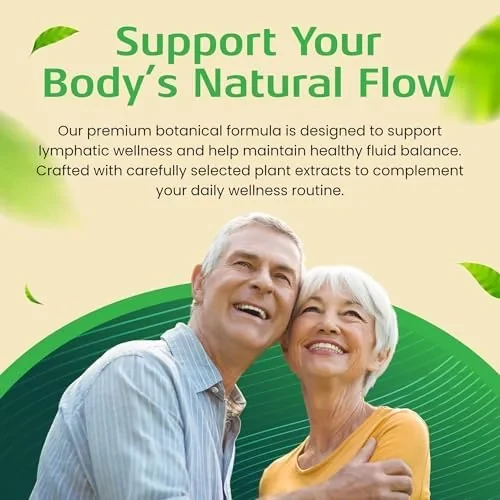
A photograph like that is the oldest device in this category and it is worth naming what it does. It is not a claim, and it carries no wording at all. It still leaves an impression of an outcome that nothing on this page supports. This site publishes it with the caption attached rather than cropping it out, because the imagery is part of what a buyer is shown.
The last word belongs to what this product does not say. No claim about a disease, no timeframe, no number to fail against, and the disclaimer printed on the label and repeated on the marketing. On claim discipline this is one of the better products this desk has covered. On evidence it is thinner: the label now prints eleven amounts, in micrograms and with no context, and no trial of this formula has been published — and both sentences describe the same bottle.
Questions
Lymph Savior FAQ: benefits questions
What does “Advanced Lymphatic Health Support” mean?
It is a structure/function claim, which FDA permits a supplement to make provided it carries the disclaimer. FDA’s own description is that such a claim may “describe the role of a nutrient or dietary ingredient intended to affect the normal structure or function of the human body”. It is not a statement that the product does anything measurable to your lymphatic system.
Is the claim on the label legal?
A support claim carrying the disclaimer is the permitted form, and this one carries it on the label and again on three marketing images. On claim discipline this product does better than several others this desk has covered.
Why does the disclaimer matter?
Because it is the sentence that tells you the claim above it has not been reviewed. FDA requires it to say that “FDA has not evaluated the claim” and that the product “is not intended to diagnose, treat, cure or prevent any disease”.
Does “Move freely through each day” mean anything specific?
No. It is a marketing line and it makes no measurable promise, which is the correct side of the line for it to be on.
References
Sources for this page
- U.S. Food and Drug Administration. Structure/Function Claims. www.fda.gov. Accessed September 24, 2026.
- U.S. Food and Drug Administration. Questions and Answers on Dietary Supplements. www.fda.gov. Accessed September 24, 2026.
- National Center for Complementary and Integrative Health. Horse Chestnut: Usefulness and Safety. www.nccih.nih.gov. Accessed September 24, 2026.
- National Center for Complementary and Integrative Health. Red Clover: Usefulness and Safety. www.nccih.nih.gov. Accessed September 24, 2026.
- NIH Office of Dietary Supplements. Dietary Supplements: What You Need to Know. ods.od.nih.gov. Accessed September 24, 2026.
- MedlinePlus, U.S. National Library of Medicine. Lymphedema. medlineplus.gov. Accessed September 24, 2026.
Next
Keep reading
See Lymph Savior on the official sales page
One support claim on the front, correctly disclaimed, and eleven botanicals behind it, each with a printed amount. Two capsules a day, thirty servings a bottle; the price is shown at checkout.
Price shown at checkout · 60-day window from the date of purchase · ships from inside the US