Official product information
The Lymph Savior Label, Set Against Its Three Marketing Cards
The printed label lists eleven botanicals, each with its own amount. Each of the three marketing cards names six of them, no card names a plant the label leaves out, and one label line, stillingia, appears on no card at all.
Written by the Lymph Savior Editorial Desk · Medical review: Dr. Carrie Lam, MD, Physician · Revised · Editorial standards
Quick answer
The Lymph Savior Supplement Facts panel prints eleven botanicals, each on its own line with its own amount. The three marketing cards are shorter lists drawn from it: each card names six of the eleven, and each picks a different six. Together they name ten; red clover, horse chestnut and burdock are on all three, and stillingia, line seven on the label, is on none. Every plant on every card is on the label, so the cards do not contradict it. They simply say less.
11 lines, 3 cards
The Lymph Savior label and three shorter lists
Every plant the seller’s artwork names is printed on the label. The label simply prints more of them.
Three pieces of Lymph Savior artwork set out what is in the capsule, and each gives a different answer. The card headed “Inside Lymph Savior — six named ingredients” lists red clover, horse chestnut, red root, Centella asiatica, burdock and yerba mate, and the “How Lymph Savior Works” card repeats that same six. The square headed “Key Botanicals in Every Capsule” keeps red clover, horse chestnut, burdock and Centella asiatica, then names olive leaf and cleavers where the first card had red root and yerba mate. The square headed “Powered by Traditional Botanicals” keeps red clover, horse chestnut, burdock and yerba mate, then names ginger root and echinacea where the first card had red root and Centella. Across the three cards that makes ten different botanicals, with red clover, horse chestnut and burdock on every one.
On their own, the cards cannot tell you which of those lists is the formula. The label can. The full label artwork, published on the brand’s own storefront and read by this desk on September 26, 2026, carries a Supplement Facts panel of eleven lines, each with its own amount per two-capsule serving. All ten carded plants are on it. So is an eleventh, stillingia (Stillingia sylvatica root extract, 100 mcg), which no card mentions. Read against the label, the three cards stop looking like rival formulas and start looking like what they are: marketing that names fewer plants than the bottle carries.
The rest of this page sets the three cards against that label, line by line: which plants each card names, which it leaves out, and where every one of them sits on the printed panel, which is reproduced in full on this site’s Supplement Facts page.
11 rows, 3 cards
Eleven Lymph Savior label lines against three cards
Every line of the printed panel, in the printed order, and which cards name it.
| Botanical, as the label describes it | Label line and amount per serving | “Inside Lymph Savior” | “Key Botanicals” | “Traditional Botanicals” | Cards |
|---|---|---|---|---|---|
| Red Clover Red Clover Extract, leaves and flowers | Line 1 · 225 mcg | ✓ | ✓ | ✓ | 3 of 3 |
| Horse Chestnut Aesculus hippocastanum seed extract, std. to 20% aescin | Line 2 · 200 mcg | ✓ | ✓ | ✓ | 3 of 3 |
| Red Root Red Root Powder | Line 3 · 210 mcg | ✓ | — | — | 1 of 3 |
| Centella asiatica extract of the aerial parts, also called gotu kola | Line 4 · 125 mcg | ✓ | ✓ | — | 2 of 3 |
| Burdock Burdock Powder, root | Line 5 · 100 mcg | ✓ | ✓ | ✓ | 3 of 3 |
| Yerba Mate Ilex paraguayensis extract, leaves | Line 6 · 100 mcg | ✓ | — | ✓ | 2 of 3 |
| Stillingia Stillingia sylvatica extract, root | Line 7 · 100 mcg | — | — | — | 0 of 3 |
| Olive Leaf Olive Leaf Extract, 20% oleuropein | Line 8 · 75 mcg | — | ✓ | — | 1 of 3 |
| Cleavers Galium aparine extract, whole herb | Line 9 · 75 mcg | — | ✓ | — | 1 of 3 |
| Ginger Root Ginger Powder, root | Line 10 · 50 mcg | — | — | ✓ | 1 of 3 |
| Echinacea Echinacea purpurea Powder, leaf, stem and flower | Line 11 · 25 mcg | — | — | ✓ | 1 of 3 |
A tick means the card names that label line; a dash means it does not. Three rows carry three ticks, and one row, stillingia, carries none. The amounts are the label’s own, printed in micrograms (mcg) for every line and copied here in that unit; the label marks each line “Daily Value not established”.
Read the table down the rows and the pattern is plain. The “Inside Lymph Savior” card, and the “How Lymph Savior Works” card that repeats it, name label lines one to six. Lines seven to eleven are on neither of them. The two squares each borrow two of those lower lines — olive leaf and cleavers on one, ginger and echinacea on the other — and leave out two of the first six to keep to six names. Stillingia is the only line that no square picks up.
Each card, in other words, is a short selection from one eleven-line panel, drawn to fill a six-name layout. That is common in marketing artwork and it is not a fault in the capsule, but it does mean no single card is the ingredient list. The panel is, and it is the only document here that puts an amount against each name.
01 pick a card
The three Lymph Savior cards, one at a time
The same eleven label lines, sorted by card instead. Each pane lists what that piece of artwork names, where those plants sit on the printed panel, and which label lines the card leaves out.
“Inside Lymph Savior”
Headed “six named ingredients” and repeated on the “How Lymph Savior Works” card. Its six are the first six lines of the label.
Names 6: Red Clover (line 1), Horse Chestnut (line 2), Red Root (line 3), Centella asiatica (line 4), Burdock (line 5), Yerba Mate (line 6).
Leaves out 5 label lines: Stillingia, Olive Leaf, Cleavers, Ginger Root, Echinacea (lines 7 to 11).
“Key Botanicals in Every Capsule”
The strongest wording of the three — in every capsule — and the label bears it out: all six plants on this card are printed on the panel.
Names 6: Red Clover (line 1), Horse Chestnut (line 2), Centella asiatica (line 4), Burdock (line 5), Olive Leaf (line 8), Cleavers (line 9).
Leaves out 5 label lines: Red Root, Yerba Mate, Stillingia, Ginger Root, Echinacea.
“Powered by Traditional Botanicals”
Adds ginger root and echinacea and stages the bottle beside a ginger rhizome and an echinacea flower. Both are on the label, as its two smallest lines: ginger powder at 50 mcg and echinacea at 25 mcg per serving.
Names 6: Red Clover (line 1), Horse Chestnut (line 2), Burdock (line 5), Yerba Mate (line 6), Ginger Root (line 10), Echinacea (line 11).
Leaves out 5 label lines: Red Root, Centella asiatica, Stillingia, Olive Leaf, Cleavers.
02 added and left out
The two Lymph Savior squares that reach further down the label
Here are the two squares whose lists differ from the “Inside” card. They are published in full rather than cropped, because they are the pieces of artwork a buyer is most likely to read as an ingredient list. Each caption says what that card adds, what it leaves out, and where those plants sit on the printed panel.
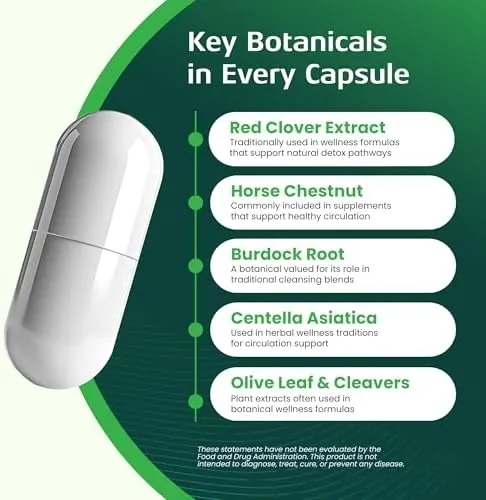
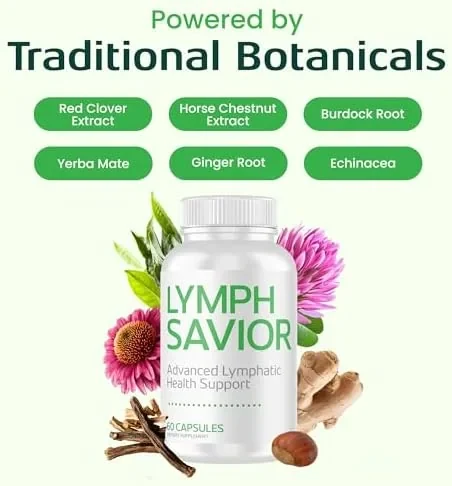
Two cards, four label lines between them that the “Inside” card does not name, and every one of the four printed on the panel.
5 lines 7 to 11
Lymph Savior label lines seven to eleven
The five lines the “Inside” card leaves out. Two have an NCCIH consumer page; for the other three this site found none.
The “Inside Lymph Savior” card stops at line six. The five lines below it are stillingia (100 mcg), olive leaf (75 mcg, standardised to 20% oleuropein), cleavers (75 mcg), ginger (50 mcg) and echinacea purpurea (25 mcg). Four of them turn up on one square each; stillingia turns up on none. Here is what the federal consumer pages hold on each, because the split is still instructive.
Ginger root — NCCIH has a page
Ginger is one of the most studied botanicals in commerce and NCCIH publishes a consumer page on it. The finding it leads with is specific and narrow: “Research shows that ginger may be helpful for nausea and vomiting associated with pregnancy.” That is a genuine result, and it is about nausea in pregnancy, not about lymph. NCCIH also names side effects: “Ginger can have side effects such as abdominal discomfort, heartburn, diarrhea, and mouth and throat irritation when taken orally.”
Echinacea — NCCIH has a page
Echinacea also has an NCCIH page, and its finding is hedged in the way an honest summary of mixed evidence usually is: “Taking echinacea may slightly reduce your chances of catching a cold. It’s still unclear whether echinacea can shorten the length of a cold. More research is needed to confirm these findings.” The safety note matters more than the efficacy note here, because it concerns a whole plant family: “However, some people have allergic reactions to echinacea, which may be severe. The most common side effects of echinacea are digestive tract symptoms, such as abdominal pain, nausea, or stomach pain.”
The same NCCIH page lists possible interactions, including with immunosuppressants and with caffeine. That second one is worth a moment on this label, because yerba mate, line six, contains caffeine and the label does not say how much.
Olive leaf, cleavers and stillingia — no consumer page found
For olive leaf, cleavers and stillingia this site found no consumer page on NCCIH, at NIH’s Office of Dietary Supplements or on MedlinePlus. They sit alongside red root, Centella asiatica, burdock and yerba mate in that respect: seven of the eleven label lines have no federal consumer page that this desk could find, which says nothing for or against the plants themselves.
What has changed is the question these five raise. Before the label was read, a reader could not tell whether any of them was in the capsule; the label says all five are, in the amounts above. What it cannot tell you is what those amounts do, and no trial of this formula has been published. If you wanted the echinacea or the ginger in particular, take the printed figure to a pharmacist or doctor rather than relying on the artwork.
03 one comparison
What a Lymph Savior buyer can do with this
The practical version is short. If you are buying this product for a particular botanical on one of the squares — the echinacea, the olive leaf, the ginger — the label confirms it is in the capsule and prints its amount per two-capsule serving. If you are trying to avoid a particular plant, read all eleven lines rather than any one card, because a plant can be on the label without being on the card you happened to see; stillingia is the clearest case. The full panel, the other-ingredients line (a gelatin capsule and brown rice flour) and the label’s caution are set out on the Supplement Facts page.
One comparison is worth making when the parcel arrives. The order page shows only the front of the bottle, and this site’s reading comes from the label artwork on the brand’s storefront, so hold the panel on the bottle you receive against the one on this site. If they differ, go by the bottle. And if you are pregnant or nursing, under 18, or living with a known medical condition, the label itself asks you to consult a physician before using it.
The general rule is the one worth keeping after you close the tab: when two pieces of a seller’s own artwork disagree about what is in a product, the artwork is not the source of truth. Marketing squares are made by designers working from briefs, they are reused between products, and they are updated on a different schedule from the label. The label is the document, and on this product it settles the question: every carded plant is on it, along with one more.
The home page carries an interactive version of the card comparison — open it on the home page rather than having it rebuilt here.
Questions
Lymph Savior FAQ: ingredient lists questions
Why do the three marketing cards list different ingredients?
Because each card names six plants and the label prints eleven. The “Inside Lymph Savior” and “How Lymph Savior Works” cards name label lines one to six. The “Key Botanicals in Every Capsule” card names olive leaf and cleavers in place of red root and yerba mate. The “Powered by Traditional Botanicals” card names ginger root and echinacea in place of red root and Centella asiatica. We do not know why the designers chose different sixes, but no card names a plant that is not on the label.
So how many botanicals are there altogether?
Eleven, on the printed Supplement Facts panel. Ten of them appear on at least one card, and red clover, horse chestnut and burdock appear on all three. The eleventh, stillingia root extract at 100 mcg per serving, appears only on the label.
Which list should I believe?
The label’s. Its panel prints all eleven botanicals with an amount against each, and every card list is a subset of it. The checkout page shows only the front of the bottle, so compare the panel on the bottle you receive with the one this site reproduces on its Supplement Facts page.
What about olive leaf, cleavers, ginger and echinacea?
All four are on the label: olive leaf extract (20% oleuropein) and cleavers extract at 75 mcg each, ginger powder at 50 mcg and echinacea purpurea powder at 25 mcg per two-capsule serving. Ginger and echinacea have NCCIH consumer pages; this site found none for olive leaf or cleavers.
References
Sources for this page
- National Center for Complementary and Integrative Health. Ginger: Usefulness and Safety. www.nccih.nih.gov. Accessed September 24, 2026.
- National Center for Complementary and Integrative Health. Echinacea: Usefulness and Safety. www.nccih.nih.gov. Accessed September 24, 2026.
- NIH Office of Dietary Supplements. Botanical Dietary Supplements: Background Information. ods.od.nih.gov. Accessed September 24, 2026.
- National Center for Complementary and Integrative Health. Dietary and Herbal Supplements. www.nccih.nih.gov. Accessed September 24, 2026.
- U.S. Food and Drug Administration. Questions and Answers on Dietary Supplements. www.fda.gov. Accessed September 24, 2026.
Next
Keep reading
Every Lymph Savior botanical
Each plant on the label, read against the federal record, with the amount the label prints.
Read it →The panel that settles this
All eleven lines of the Lymph Savior Supplement Facts panel in printed order, with the other ingredients and the caution.
Read it →A method, not just a finding
What to do the next time a product’s own marketing contradicts itself.
Read it →See Lymph Savior on the official sales page
Ten plants across three cards, eleven on the label, and an amount for every one of them. Two capsules a day, thirty servings a bottle; the price is shown at checkout.
Price shown at checkout · 60-day window from the date of purchase · ships from inside the US