Official product information
How to Take Lymph Savior: Dose, Water and Timing
Two capsules daily with 6–8 oz of water, what the instruction does and does not specify, the 60-day window, and the twelve-week figure attached to horse chestnut, one of the eleven ingredients on the label.
Written by the Lymph Savior Editorial Desk · Medical review: Dr. Carrie Lam, MD, Physician · Revised · Editorial standards
Quick answer
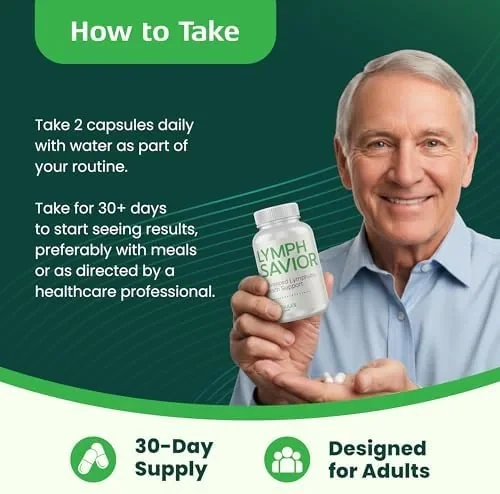
Take two capsules a day with 6 to 8 oz of water.
A bottle holds 60 capsules, so it lasts thirty days. The label does not name a time of day or say whether to take it with food.
Check what is in each serving on the Supplement Facts page.
2 capsules daily
The Lymph Savior directions, in full
Two capsules, 6–8 oz of water, thirty days a bottle — and the arithmetic agrees with itself.
The directions printed on the label read, in full: “As a dietary supplement, adults take two (2) capsules daily. For best results, take with 6-8 oz of water or as directed by a healthcare professional.” Two capsules a day out of a bottle of sixty is thirty days, which matches the 30 SERVINGS roundel printed on the front of the bottle. That much is internally consistent and it is worth saying so before anything else on this page.
Take two capsules a day
The instruction says two (2) capsules daily and does not split them across the day. Two capsules out of a bottle of sixty is thirty days, and the front roundel prints 30 SERVINGS to agree with it.
Take them with 6–8 oz of water
About 180 to 240 millilitres — a small glass. It is a specific instruction, and specifying it at all is more than most capsule labels bother to do.
Pick a time and keep it
Nothing on the label names a time of day. A fixed time is the easiest way to remember a daily capsule, which is a practical reason rather than a pharmacological one. If the caffeine in the yerba mate is a question for you, morning is the cautious choice.
Write down the date you paid
Not the date the parcel arrived and not the date of the first capsule. The 60-day guarantee window runs from purchase, so that is the date the calendar needs.
Check the panel on the bottle you receive
The checkout page shows only the front of the bottle. When the parcel arrives, turn the bottle round and compare its Supplement Facts panel, its other-ingredients line and its caution with the reading on this site. If anything differs, the bottle in your hand wins.
8.0 the highest row on the card
Why the arithmetic closing exactly is worth praising
It is worth pausing on how rare that paragraph is, because this site is hard on the product almost everywhere else and this row is the one it scores highest.
Four figures, and they all agree
Sixty capsules on the front of the bottle. Two capsules a day in the instruction. Thirty servings inside the front roundel. Thirty days a bottle when you do the division. Four numbers printed or implied in four different places on the packaging, and every one of them is consistent with the other three. The Supplement Facts panel then repeats two of them in its opening lines: Serving Size 2 Capsules, Servings Per Container 30. A reader can work out how long a bottle lasts without asking anybody, and can check their own answer against the roundel.
Why that is not a trivial thing to get right
Plenty of supplement labels print a count that does not divide evenly into the stated serving, or a servings figure that quietly assumes a different dose from the one in the directions, or a “one to three capsules as needed” instruction that makes the servings figure meaningless. Any of those leaves the buyer to work out their own dose, which is precisely the job a label is meant to do for them. Lymph Savior does none of that. The dose is a single number, it is not a range, and the arithmetic closes.
The panel carries that credit one step further. A clear instruction to take two capsules is an instruction about how many capsules; the Supplement Facts panel answers the next question, how much of what. Two capsules make one serving, and the panel lists eleven botanical lines for that serving, each with its own amount rather than a blend total, every figure printed in micrograms (mcg): red clover first at 225 mcg, echinacea last at 25 mcg. What neither the directions nor the panel can tell you is what those amounts do, because no trial of this formula has been published. The Supplement Facts page copies all eleven lines in the order the label prints them.
01 what the label does not say
Timing, food, missed days, and opening the capsule
With food, or without?
The instruction does not say. It specifies water and it specifies a healthcare professional’s direction as the alternative, and it stops there. One of the supplied marketing cards suggests taking it preferably with meals; that is the card talking, not the label, and this page keeps the two apart. If a capsule sits badly on an empty stomach — which is ordinary and not specific to this product — taking it with food is a reasonable thing to do.
Morning or evening?
Also not stated. The only reason to have a view is the yerba mate. The panel lists yerba mate extract at 100 mcg a serving, and yerba mate contains caffeine, but the label does not state how much caffeine that extract carries, so this page cannot tell you whether an evening capsule would trouble your sleep. That uncertainty is itself the argument for the morning: when the size of an effect is unknown, the cautious slot is the one that matters least.
Both capsules at once, or split?
The instruction says two capsules daily and does not divide them, so taking both together is the literal reading. NIH ODS gives the general rule for botanicals and it is worth quoting rather than paraphrasing: “Follow the manufacturer’s suggested directions for using a botanical and do not exceed the recommended dose unless your health care provider directs otherwise.”
A missed day
Take the next day’s two as normal and let the missed day go. Do not take four to catch up. The label’s caution opens with “Do not exceed recommended dose”, and doubling up would also double a caffeine amount the label does not state.
Opening the capsule
The label does not address it, so this page will not guess. The other-ingredients line tells you the shell is gelatin and that the one other non-botanical ingredient is brown rice flour. It does not say whether the contents can be emptied into food, whether they taste of anything, or where the shell is designed to open, and inventing an answer would be exactly the failure this site is written against. If swallowing capsules is hard for you, a pharmacist is the right person to ask before you open one.
60 days from purchase
Two capsules a day against a 60-day window
The clock starts the day you pay, and only one of the four packs ends on the same day it does.
The pack states 60 days from purchase, unless the sales page prints a longer window. Read that carefully: the clock starts the day you pay, not the day you open the bottle. A parcel that sits unopened for a fortnight has spent a fortnight of the window.
Set the window against the packs at two capsules a day. One bottle is 30 days — a month inside the window. Two bottles is 60 days — the product and the guarantee end on the same day, which is the neatest fit of the four. Three bottles is 90 days, so 30 days of product sit outside it. Six bottles is 180 days, and when the window shuts four bottles are still sealed. The pack the seller calls its top seller is the one where the guarantee expires with two thirds of the product unopened.
The discipline the window asks for
The window is a date, not a bottle count, so the only way to use it properly is to run it on a calendar. Write the purchase date down on the day you pay. Set a reminder for day fifty. Decide on that reminder rather than on how much product is left, because the product and the window only run out together on one of the four packs. If the panel on the bottle you receive differs from the one this site copies, or the gelatin capsule turns out to rule the product out for you, raise it in the first month, while a refund is still a live option rather than a retrospective one.
The home page carries a supply planner that lines each pack up against the window day by day; open the supply planner rather than working it out twice.
84 days in twelve weeks
Twelve weeks, against the three- and six-bottle packs
The published time span most worth setting against the packs belongs to a single ingredient. NCCIH, on horse chestnut: “Standardized horse chestnut seed extracts, from which this component has been removed, are likely safe for short-term use and have been used safely in research studies for up to 12 weeks.”
Twelve weeks is eighty-four days
Set that against the packs at two capsules a day. One bottle is thirty days, comfortably inside it. Two bottles is sixty days, still inside it. Three bottles is ninety days, which is past it. Six bottles is a hundred and eighty days, which is more than twice it.
Three things have to be said about that comparison so it is not overread. The sentence describes standardised horse chestnut seed extract, and this label now says that is the kind it carries: a seed extract standardised to 20% aescin, printed at 200 mcg a serving. It describes the length of the studies rather than a safety limit that has been tested and found. And it describes the research rather than this capsule: no trial of this formula has been published, so the twelve weeks tell you how long standardised seed extract was studied, not how long this product was.
What survives all three caveats is still worth having. Twelve weeks is the only time span NCCIH gives for horse chestnut seed extract, and two of the four pack sizes run longer than it. That is a fact about the packs, and it belongs next to the decision about which one to buy rather than after it.
02 one look at the bottle
Check the Lymph Savior bottle you receive
The label this site copies comes from the full label artwork published on the brand’s storefront, which this desk read on September 26, 2026. The checkout page itself shows only the front of the bottle, so the first useful thing to do when the parcel arrives is turn the bottle round and compare its back with this site. Look for eleven botanical lines in the same printed order, every amount in micrograms (mcg), “Gelatin (capsule), Brown Rice Flour” as the other ingredients, the caution, and a distributor line naming Lymph Savior of Akron, Ohio. If anything on your bottle differs, the bottle in your hand wins.
Two lines on that label deserve a second look before the first capsule. The gelatin shell settles the vegetarian question: gelatin is an animal product, so a vegetarian or vegan reader should not rely on the Vegetarian roundel in the seller’s seal set. And the caution asks that pregnant or nursing mothers, children under 18 and anyone with a known medical condition consult a physician before using the product; if that describes you, read the doctor-first note and speak to your own clinician before you start. Questions about an existing order go to the order desk listed in the site footer.
Questions
Lymph Savior FAQ: how to use questions
How do I take Lymph Savior?
The label’s directions: “As a dietary supplement, adults take two (2) capsules daily. For best results, take with 6-8 oz of water or as directed by a healthcare professional.”
With food or without?
The instruction does not say. It specifies water and it specifies a healthcare professional’s direction as an alternative. One of the supplied marketing cards suggests “preferably with meals”; that is the card, not the label.
Morning or evening?
The label does not say. Yerba mate extract is on the panel and the label does not state how much caffeine it carries, so if caffeine matters to your sleep, morning is the cautious choice. That is reasoning rather than instruction.
Can I take both capsules at once?
The instruction says two capsules daily and does not split them. NIH ODS: “Follow the manufacturer’s suggested directions for using a botanical and do not exceed the recommended dose unless your health care provider directs otherwise.”
What if I miss a day?
Take the next day’s two as normal. Do not take four to catch up: the label’s caution says “Do not exceed recommended dose.”
Can I open the capsule?
The label does not address it, so this page will not guess. It does say the shell is gelatin. If swallowing capsules is hard for you, ask a pharmacist before opening one.
References
Sources for this page
- NIH Office of Dietary Supplements. Botanical Dietary Supplements: Background Information. ods.od.nih.gov. Accessed September 24, 2026.
- National Center for Complementary and Integrative Health. Horse Chestnut: Usefulness and Safety. www.nccih.nih.gov. Accessed September 24, 2026.
- NIH Office of Dietary Supplements. Dietary Supplements: What You Need to Know. ods.od.nih.gov. Accessed September 24, 2026.
- National Center for Complementary and Integrative Health. Dietary and Herbal Supplements. www.nccih.nih.gov. Accessed September 24, 2026.
Next
Keep reading
What a capsule actually contains
All eleven lines of the Lymph Savior panel, in printed order, with every amount in mcg as the label gives it.
Read it →The 60-day window in detail
When the clock starts, what each pack does against it, and what to screenshot before you pay.
Read it →Cautions and interactions
The label’s own caution, and what the federal pages publish for the four ingredients that have one.
Read it →See the Lymph Savior packs on the official page
Two capsules daily with 6–8 oz of water, sixty capsules a bottle, thirty days a bottle, and a serving line on the panel that matches the directions. The price is shown at checkout.
Price shown at checkout · 60-day window from the date of purchase · ships from inside the US