Official product information
Lymph Savior Ingredients: The Eleven Botanicals on the Label
Eleven botanicals in the order the Supplement Facts panel prints them, each with the amount printed beside it and a check against the federal consumer record.
Written by the Lymph Savior Editorial Desk · Medical review: Dr. Carrie Lam, MD, Physician · Revised · Editorial standards
Quick answer
Lymph Savior contains eleven botanicals, each printed with its own amount, so there is no proprietary blend.
They are red clover, horse chestnut, red root, Centella asiatica, burdock, yerba mate, stillingia, olive leaf, cleavers, ginger and echinacea, from 225 mcg of red clover down to 25 mcg of echinacea per two-capsule serving.
To see the panel line by line, read the Supplement Facts.
11 lines, 11 amounts
The eleven Lymph Savior label lines, in the order printed
The panel is short and legible. This page keeps its order exactly, including the one place where the order does not follow the size of the amount.
The Supplement Facts panel sets a serving at two capsules, thirty servings to a bottle, and then gives every botanical its own line and its own amount. In the order printed: red clover extract from the leaves and flowers, 225 mcg; horse chestnut seed extract standardised to 20% aescin, 200 mcg; red root powder, 210 mcg; Centella asiatica extract from the aerial parts, 125 mcg; burdock root powder, 100 mcg; yerba mate leaf extract, 100 mcg; stillingia root extract, 100 mcg; olive leaf extract standardised to 20% oleuropein, 75 mcg; cleavers extract from the whole herb, 75 mcg; ginger root powder, 50 mcg; and Echinacea purpurea powder from the leaf, stem and flower, 25 mcg.
Every figure on the panel is in micrograms, and this site copies it that way. We do not convert the unit or tidy the order, which is why red root’s 210 mcg is listed after horse chestnut’s 200 mcg here, exactly as it is on the label. Each line is marked “Daily Value not established”, the usual note for botanicals, which have no reference intake. Beneath the panel, the other ingredients are gelatin, which forms the capsule, and brown rice flour.
This reading comes from the full label artwork the brand publishes on its storefront, read on September 26, 2026. The order page itself shows only the front of the bottle, so when yours arrives, set its panel beside this one. If anything differs, the bottle in your hand is the one to follow.
11
11 of 11
4 of 11
7 of 11
2
mcg
01 turn each one
The eleven Lymph Savior botanicals as cards, front and back
Front: the plant and the amount the label prints for it. Back: what the federal record holds, where this site found a page.
225 mcg
Red Clover Extract
A pasture legume, used as the flower head and the leaf, and the largest amount on the panel. One of four rows here with an NCCIH page behind it.
Tap to turnNCCIH consumer page
Red Clover Extract
NCCIH opens with the chemistry: “Red clover contains substances called isoflavones that are structurally similar to estrogen.”
Tap to turn back200 mcg
Horse Chestnut Extract
The seed of Aesculus hippocastanum, printed as an extract standardised to 20% aescin. The row with the clearest federal finding, though not a lymphatic one.
Tap to turnNCCIH consumer page
Horse Chestnut Extract
NCCIH: “A 2012 systematic review of 17 studies suggested that horse chestnut seed extract can improve symptoms of CVI.” CVI is a disorder of the veins in the legs.
Tap to turn back210 mcg
Red Root Powder
Ceanothus americanus, also called New Jersey tea. In herbal tradition this is the lymphatic herb. Printed third, just after horse chestnut’s smaller figure.
Tap to turnNo federal page found
Red Root Powder
This site found no consumer page on NCCIH, NIH ODS or MedlinePlus, so there is little federal reading to offer on it.
Tap to turn back125 mcg
Centella asiatica Extract
The aerial parts of the plant usually sold as gotu kola. On two of the three marketing cards.
Tap to turnNo federal page found
Centella asiatica Extract
This site did not find it in NCCIH’s Herbs at a Glance index, on the ODS fact sheet list or on MedlinePlus.
Tap to turn back100 mcg
Burdock Powder
The root, a food in several cuisines. One of only three botanicals all three marketing cards agree on.
Tap to turnNo federal page found
Burdock Powder
On every marketing card, and on no federal consumer page this site could find: the agreement tells you about the artwork, not the plant.
Tap to turn back100 mcg
Yerba Mate Extract
The leaf of Ilex paraguayensis. It contains caffeine, and the label gives the weight of the extract, not the caffeine it brings.
Tap to turnNo federal page found
Yerba Mate Extract
This site found no page on NCCIH, ODS or MedlinePlus. FDA on caffeine adds that “However, there is wide variation in both how sensitive people are to the effects of caffeine and how fast they eliminate it from the body.”
Tap to turn back100 mcg
Stillingia Extract
Root extract of Stillingia sylvatica, seventh on the panel. The one label line that none of the three marketing cards names.
Tap to turnNo federal page found
Stillingia Extract
No consumer page turned up on NCCIH, NIH ODS or MedlinePlus in this site’s search. For now the label line is most of what a buyer has to go on.
Tap to turn back75 mcg
Olive Leaf Extract
Extract of the olive tree’s leaf, standardised to 20% oleuropein: one of two lines on the panel with a printed standardisation.
Tap to turnNo federal page found
Olive Leaf Extract
This site found no federal consumer page for olive leaf. It is named on one marketing card, the “Key Botanicals in Every Capsule” square, and the label bears that card out.
Tap to turn back75 mcg
Cleavers Extract
Galium aparine, used as the whole herb. Named on one marketing card, the “Key Botanicals” square.
Tap to turnNo federal page found
Cleavers Extract
Nothing on NCCIH, NIH ODS or MedlinePlus that this site could locate. The printed amount is the one fact the label adds.
Tap to turn back50 mcg
Ginger Powder
Powdered ginger root. It is on one marketing card, and it is the only plant in the bottle photograph that the label also lists.
Tap to turnNCCIH consumer page
Ginger Powder
NCCIH keeps a consumer page on ginger, which makes this one of the four label lines with federal reading behind it. The link is in the row-by-row section below.
Tap to turn back25 mcg
Echinacea purpurea Powder
Leaf, stem and flower of Echinacea purpurea, powdered. The smallest amount on the panel, named on one marketing card.
Tap to turnNCCIH consumer page
Echinacea purpurea Powder
NCCIH notes allergic reactions, which may be severe, digestive side effects, and possible interactions with immunosuppressants and with caffeine.
Tap to turn back02 solid or hatched
Four of eleven Lymph Savior botanicals have an NCCIH page
A solid bar means there is a federal consumer page to read. A hatched bar means this site did not find one.
Four of the eleven have a consumer page written by NCCIH, part of the National Institutes of Health: red clover, horse chestnut, ginger and echinacea. For the other seven, this site found no consumer page on NCCIH, NIH ODS or MedlinePlus. Those seven bars are hatched rather than filled, because a hatched bar draws an absence of reading material: it is not a low score, it is an empty shelf.
The bar measures one thing only: whether this site found a consumer page about that botanical on NCCIH, NIH ODS or MedlinePlus. A solid bar means there is something federal to read. A hatched bar means this site found nothing to point to. Neither bar measures how well the ingredient works or how much of it is in a capsule; those amounts are the printed mcg figures on the cards above.
What an empty shelf does and does not mean
NCCIH writes consumer pages for the plants people ask about most, and says so itself: “The amount of scientific evidence on dietary supplements varies widely—there is a lot of information on some and very little on others.” An absent page is a fact about what has been written, not a finding against the plant. In practice it means that for seven of these eleven a buyer has no federal consumer page to read before taking them, only the label line and its printed amount.
03 row by row
All eleven Lymph Savior botanicals, one row at a time
Each one read off the Supplement Facts panel and checked against the federal record, where this site found one.
1. Red Clover Extract — 225 mcg
Red clover is a pasture legume, and the label specifies the leaves and flowers; at 225 mcg per serving it is the largest amount on the panel. NCCIH’s page opens with the chemistry rather than the folklore: “Red clover contains substances called isoflavones that are structurally similar to estrogen.” That single sentence is the reason red clover is studied at all, and it is also the reason it carries a pregnancy caution.
The evidence NCCIH describes is not about lymph. It is about menopause and cholesterol, and it is mixed. “Studies on the effects of red clover on hot flashes associated with menopause have had inconsistent results, and some of the studies had a high risk of bias.” On cholesterol: “Red clover may have a beneficial effect on cholesterol levels in postmenopausal women, but more research is needed.” On bone density the results are again “inconsistent”.
2. Horse Chestnut Extract — 200 mcg
Horse chestnut is the row where this page can quote a positive finding from a federal review. NCCIH reports: “A 2012 systematic review of 17 studies suggested that horse chestnut seed extract can improve symptoms of CVI”, and adds that “Results from one of these studies suggested that horse chestnut seed extract may be as effective as wearing compression stockings.” The review also noted “a need for more rigorous, large-scale randomized controlled trials”.
Two things have to be said next to that finding. The first is that CVI is chronic venous insufficiency — a disorder of the veins in the legs. The venous system and the lymphatic system are not the same system, and a finding about one is not evidence about the other. The second is that the research used standardised seed extract. This label prints the same kind of material, “Horse Chestnut Extract (Aesculus hippocastanum) (seed) (std. to 20% aescin)”, at 200 mcg per serving. No trial of this formula has been published, so the review describes the ingredient, not this capsule.
3. Red Root Powder — 210 mcg
Red root is the common name for Ceanothus americanus, a North American shrub also called New Jersey tea. In herbal tradition it is the lymphatic herb, which is very likely why it is on this label at all — it is the row that makes the product’s name make sense. The panel prints it third, at 210 mcg, directly under horse chestnut’s 200 mcg; the order is the label’s, and this page keeps it.
This site found no consumer page for it on NCCIH, NIH ODS or MedlinePlus.
4. Centella asiatica Extract — 125 mcg
Centella asiatica is the plant usually sold under the name gotu kola, and the label uses its aerial parts. It appears on two of the three marketing cards for this product and is absent from the third.
A search of NCCIH, NIH ODS and MedlinePlus turned up no consumer page for it.
5. Burdock Powder — 100 mcg
Burdock root is a food in several cuisines and a long-standing ingredient in traditional herbal blends. It is one of the three botanicals every one of this product’s three marketing cards agrees on, which on this product counts for something.
This desk found no federal consumer page for burdock.
6. Yerba Mate Extract — 100 mcg
Yerba mate is the leaf of Ilex paraguayensis, brewed as a drink across South America and sold as an extract in supplements. It contains caffeine. The label prints 100 mcg of the extract per serving, but it does not state how much caffeine that extract brings.
No consumer page on NCCIH, NIH ODS or MedlinePlus came up in this site’s search. FDA’s caffeine page is the relevant federal reading.
7. Stillingia Extract — 100 mcg
Stillingia is printed as an extract of the root of Stillingia sylvatica. It is the one label line that none of the three marketing cards names, so a reader who knew the product only from its cards would not know it was in the capsule. The panel is the only place it appears.
This site did not find a consumer page for it on the three federal sites it checks.
8. Olive Leaf Extract — 75 mcg
Olive leaf extract is one of two lines on this panel with a printed standardisation: 20% oleuropein. It is named on the “Key Botanicals in Every Capsule” card, and the label bears that card out.
As with most of this list, there is no federal consumer page this site can point to.
9. Cleavers Extract — 75 mcg
Cleavers is Galium aparine, and the panel says the whole herb is used. It shares its amount with olive leaf and, like olive leaf, appears on the Key Botanicals card and on neither of the others.
It has no federal consumer page that this site could locate.
10. Ginger Powder — 50 mcg
Ginger is printed as powdered root. It is named on the “Powered by Traditional Botanicals” card, and a piece of ginger also sits in the product photograph, beside lemon, mint and three kinds of berry that are not on the label. Of everything in that picture, ginger is the only plant the panel lists.
NCCIH has a consumer page on ginger, and this site points to it rather than paraphrasing it: NCCIH on ginger.
11. Echinacea purpurea Powder — 25 mcg
Echinacea closes the panel with its smallest amount: powdered leaf, stem and flower of Echinacea purpurea. It appears on the Powered by Traditional Botanicals card.
NCCIH’s echinacea page is most useful here for its safety notes. It says echinacea can cause allergic reactions, which may be severe, and digestive side effects, and that it may interact with some medicines, including immunosuppressants, and with caffeine. Yerba mate, a caffeine source, is on the same label; the side effects page covers what that means in practice.
04 the finding and the folklore
The two rows that decide how this list reads
Horse chestnut: a real finding, for a vein condition, from standardised seed extract
The finding is genuine and it deserves saying twice. It is also about chronic venous insufficiency, a disorder of the veins in the legs, and the venous system is not the lymphatic system. The research behind it used standardised seed extract, and this label names that kind of material: seed extract standardised to 20% aescin. What the label cannot offer is a trial of this formula, because none has been published. The safety language on this row is sharper than on any other: NCCIH says “The raw seeds, bark, flowers, and leaves of horse chestnut are unsafe when used orally because they contain a toxic component.” Only the processed material is considered likely safe, and on that point the label is specific: it names a standardised seed extract, not raw seed.
Red root: the row that makes the name make sense, and the row with the least federal reading
Red root is almost certainly why this product is called what it is called. It is printed third, at 210 mcg, and among the marketing cards it appears only on the “Inside Lymph Savior” card and on the “How Lymph Savior Works” card that repeats it. This site found no federal consumer page for it. So the ingredient most tied to the name now has a printed amount, but no federal consumer information behind it. That does not make red root harmful. It makes it hard to check, which is a different thing and the accurate one.
The panel gives each line its own figure, and this site copies each one as printed, unit included. If the bottle you receive shows anything different, the bottle in your hand wins; compare it with the panel as this site reads it.
05 six of eleven
The Inside Lymph Savior card, six names from an eleven-line label
The card below is the seller’s “Inside Lymph Savior” card. It sets six plants around the bottle, the first six lines of the label, under the heading six named ingredients. The label lists eleven. Nothing on the card contradicts the panel; it simply names fewer plants, and the five it leaves out are stillingia, olive leaf, cleavers, ginger and echinacea.
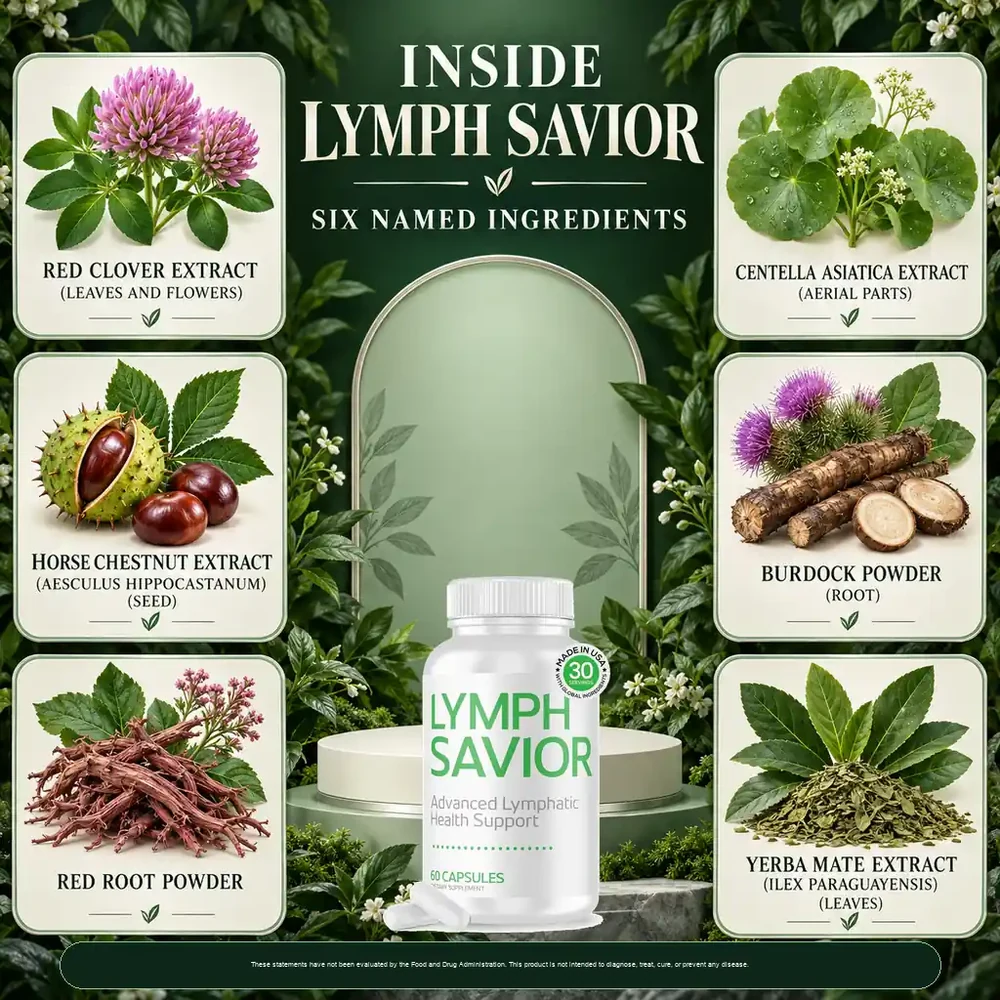
NIH’s Office of Dietary Supplements puts the general problem in one sentence — “Determining the quality of a botanical dietary supplement product from its label is difficult.” — and a complete panel does not change that. It tells you what is meant to be in the capsule and how much; it cannot tell you how the plant material was sourced or tested.
Questions
Lymph Savior FAQ: ingredients questions
What are the eleven ingredients?
In the order printed, per two-capsule serving: red clover extract (leaves and flowers) 225 mcg; horse chestnut extract (Aesculus hippocastanum, seed, standardised to 20% aescin) 200 mcg; red root powder 210 mcg; Centella asiatica extract (aerial parts) 125 mcg; burdock powder (root) 100 mcg; yerba mate extract (Ilex paraguayensis, leaves) 100 mcg; stillingia extract (Stillingia sylvatica, root) 100 mcg; olive leaf extract (20% oleuropein) 75 mcg; cleavers extract (Galium aparine, whole herb) 75 mcg; ginger powder (root) 50 mcg; and Echinacea purpurea powder (leaf, stem, flower) 25 mcg. The capsule is gelatin, and brown rice flour is the other listed ingredient.
Which ingredients have federal information behind them?
Four of the eleven. NCCIH has consumer pages on red clover, horse chestnut, ginger and echinacea. For red root, Centella asiatica, burdock, yerba mate, stillingia, olive leaf and cleavers, this site found no consumer page on NCCIH, NIH ODS or MedlinePlus.
Is a vein finding the same as a lymphatic finding?
No. The venous system and the lymphatic system are different systems. A positive finding about leg veins is not evidence about lymph, and this site will not present it as one.
What is red root?
Ceanothus americanus, a North American shrub also called New Jersey tea. It is the ingredient most associated with lymphatic folklore. The label prints it at 210 mcg per serving, and this site found no consumer page for it on NCCIH, NIH ODS or MedlinePlus.
References
Sources for this page
- National Center for Complementary and Integrative Health. Red Clover: Usefulness and Safety. www.nccih.nih.gov. Accessed September 24, 2026.
- National Center for Complementary and Integrative Health. Horse Chestnut: Usefulness and Safety. www.nccih.nih.gov. Accessed September 24, 2026.
- NIH Office of Dietary Supplements. Botanical Dietary Supplements: Background Information. ods.od.nih.gov. Accessed September 24, 2026.
- National Center for Complementary and Integrative Health. Dietary and Herbal Supplements. www.nccih.nih.gov. Accessed September 24, 2026.
- U.S. Food and Drug Administration. Spilling the Beans: How Much Caffeine is Too Much?. www.fda.gov. Accessed September 24, 2026.
- National Center for Complementary and Integrative Health. Ginger: Usefulness and Safety. www.nccih.nih.gov. Accessed October 1, 2026.
- National Center for Complementary and Integrative Health. Echinacea: Usefulness and Safety. www.nccih.nih.gov. Accessed October 1, 2026.
Next
Keep reading
The Supplement Facts panel, line by line
Serving size, the eleven amounts in mcg, other ingredients and the caution.
Read it →Three cards against an eleven-line label
Each card names six plants, and stillingia appears on none of them.
Read it →What the federal lymph pages say
The lymphatic system, lymphedema and what treats it.
Read it →See Lymph Savior on the official sales page
Eleven botanicals, an amount on every line and no proprietary blend. Two capsules daily with 6–8 oz of water, thirty days a bottle; the price is shown at checkout.
Price shown at checkout · 60-day window from the date of purchase · ships from inside the US