Official product information
Lymph Savior Supplement Facts: Serving, Amounts and Capsule
The eleven-line panel printed on the back of the bottle, the serving it is measured against, the capsule it comes in, and the caution and distributor lines underneath.
Written by the Lymph Savior Editorial Desk · Medical review: Dr. Carrie Lam, MD, Physician · Revised · Editorial standards
Quick answer
A Lymph Savior serving is 2 capsules, and each bottle holds 30 servings.
Eleven botanicals each have their own amount in mcg, from 225 mcg of red clover to 25 mcg of Echinacea purpurea. Other ingredients are gelatin and brown rice flour.
11 lines, each with its own amount
The Lymph Savior Supplement Facts panel, and where this reading comes from
A two-capsule serving, thirty servings to the bottle, and an amount printed beside every botanical.
Every dietary supplement sold in the United States carries a Supplement Facts panel: the block that states the serving size, the servings in the container, each dietary ingredient by name, the amount of each one in a serving, and a Daily Value where one has been set. On Lymph Savior the panel opens with Serving Size 2 Capsules and Servings Per Container 30, then lists eleven botanicals. Each of the eleven has a figure of its own. That makes it an itemised panel rather than a proprietary blend, so you can see how much of each plant the label declares instead of a single total for the lot.
Every amount on it is printed in micrograms (mcg). We copy that unit exactly as the label gives it and do not restate it in any other unit. Nor do we set any figure on this panel beside research doses. No trial of this formula has been published, and the one ingredient with a positive federal review finding, horse chestnut, was studied as a standardized seed extract for a vein condition rather than a lymphatic one.
The full label artwork published on the brand’s storefront, read on September 26, 2026. If the panel on the bottle you receive ever differs from the table on this page, go by the bottle: it describes the batch you actually hold.
7 lines that do a job
What a Supplement Facts panel has to carry, and what the Lymph Savior label puts there
Seven kinds of line, what each buys the reader, and how this label fills it.
A Supplement Facts panel is a short, rigid block of type, and every line in it does a job. Here is each job, with what the Lymph Savior label prints in that place.
Serving size
The first line says what one serving is, and everything below it is expressed per serving. This label prints Serving Size 2 Capsules, which agrees with the directions: adults take two capsules daily, with 6–8 oz of water or as a healthcare professional directs. Every amount further down is for those two capsules together.
Servings per container
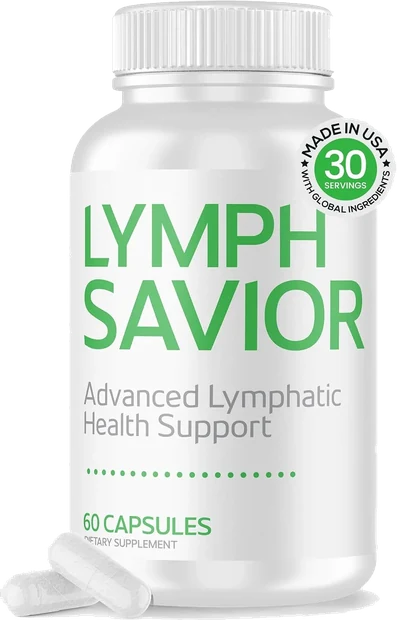
The second line turns a bottle into a length of time. The panel prints 30, the front roundel prints 30 SERVINGS, and sixty capsules at two a day comes to the same thirty.
Each dietary ingredient, by name
For a botanical the useful name includes the species and the part used, since a root and a leaf of one species are not the same material. Ten of the eleven lines give the part, in brackets or in the name itself (olive leaf), and six carry a Latin name, from Aesculus hippocastanum for horse chestnut to Galium aparine for cleavers. Red root powder is the one line with neither.
The amount of each one
This is the line the panel exists for, and every Lymph Savior line has one, in mcg. ODS gives the reason a figure matters more for a botanical than for most things: “the same amount of a botanical may be contained in a cup of tea, a few teaspoons of tincture, or an even smaller amount of an extract”
The Daily Value, where one is set
Beside each amount sits the percentage of the Daily Value where one exists. For vitamins and minerals that column fills up; for these eleven botanicals it has nothing to report.
The footnote, where one is not
The label marks every line with a symbol pointing to the words Daily Value not established. That footnote is not a blank: it says no reference intake has been set for this material, so the amount is the only yardstick the panel offers.
The other-ingredients line
Under the panel the label prints Other Ingredients: Gelatin (capsule), Brown Rice Flour. That settles the shell: it is gelatin, an animal product. The seller’s seal set includes a vegetarian roundel, and the two cannot both describe this capsule, so a vegetarian or vegan reader should go by the ingredient line and not rely on that seal.
01 the panel, transcribed
The eleven lines on the Lymph Savior panel
In the order the label prints them, with every amount in the unit the label uses.
| # | Line as printed | Amount per serving | Daily Value |
|---|---|---|---|
| 1 | Red Clover Extract (leaves and flowers) | 225 mcg | Not established |
| 2 | Horse Chestnut Extract (Aesculus hippocastanum) (seed) (std. to 20% aescin) | 200 mcg | Not established |
| 3 | Red Root Powder | 210 mcg | Not established |
| 4 | Centella asiatica Extract (aerial parts) | 125 mcg | Not established |
| 5 | Burdock Powder (root) | 100 mcg | Not established |
| 6 | Yerba Mate Extract (Ilex paraguayensis) (leaves) | 100 mcg | Not established |
| 7 | Stillingia Extract (Stillingia sylvatica) (root) | 100 mcg | Not established |
| 8 | Olive Leaf Extract (20% oleuropein) | 75 mcg | Not established |
| 9 | Cleavers Extract (Galium aparine) (whole herb) | 75 mcg | Not established |
| 10 | Ginger Powder (root) | 50 mcg | Not established |
| 11 | Echinacea purpurea Powder (leaf, stem, flower) | 25 mcg | Not established |
Eleven lines, eleven separate amounts, and no blend heading anywhere on the panel.
Two details are worth knowing before you set this table against your own bottle. The order is the label’s, not ours: red root powder at 210 mcg is printed third, below horse chestnut at 200 mcg, and we have left it where it is rather than re-sort it. The unit is the label’s too. Every line reads mcg, and that is how we reproduce it.
Two lines name a standardisation. The horse chestnut is a seed extract standardised to 20% aescin, and the olive leaf extract is standardised to 20% oleuropein; the other nine name none. Yerba mate contains caffeine, and the label does not state how much a serving carries. None of this appears on the front of the bottle, which prints the brand, Advanced Lymphatic Health Support, 60 capsules, the words dietary supplement and a roundel reading Made in USA with global ingredients · 30 servings.
9 questions for the label
Nine questions the Lymph Savior label answers, or leaves open
Each is a question a buyer would normally settle by turning the bottle around.
Nine things a reader would ordinarily want from a supplement label, and what this one says about each. Four are settled outright, three in part, and two stay open.
Settled. All eleven lines carry an amount per two-capsule serving, printed in mcg.
Settled: there is none. Each botanical has its own figure.
Settled. Gelatin (capsule), with brown rice flour, so the seller’s vegetarian seal is not one to rely on.
Settled. The line names the seed and 20% aescin. NCCIH describes standardized seed extract as likely safe short term, and raw seed, bark, flower and leaf as unsafe to swallow.
Open. Yerba mate contains caffeine and the label gives no figure. The 400 mg a day FDA cites for healthy adults is a caffeine guide, not a label amount.
Caution settled, interactions open. Pregnancy, nursing, under-18s and known medical conditions are named; medicines are not.
In part. “No added: eggs, dairy, wheat, preservatives” covers what was left out; the full ingredient list covers the rest.
In part. A distributor in Akron, Ohio is printed, with its own phone line and email. No manufacturer is named.
Open here. Artwork shows the design, not a batch, so look for a lot number and date on the bottle you receive; the seller’s pack places them on the base.
Why standardisation is on that list
ODS describes standardisation plainly — “Standardization is a process that manufacturers may use for extracts to ensure that all of their batches are similar.” — and is equally plain that it is optional: “U.S. law does not require dietary supplements to be standardized.” A standardised extract names its marker compound, so it can be described in the same terms as the preparations used in research. On this label that holds for horse chestnut and olive leaf only.
And why a label is not the last word on quality
ODS again: “Determining the quality of a botanical dietary supplement product from its label is difficult.” That holds even for a complete panel like this one. The label is what the distributor declares, not a laboratory result and not evidence that the formula does anything. What it gives you is a fixed text to check the bottle against.
02 caution to distributor
The other lines on the Lymph Savior back label
The “No added” line
The label prints No added: eggs, dairy, wheat, preservatives: none of those four went into the formula. For anything else you avoid, check the eleven panel lines and the two other ingredients.
The caution
The caution opens with “Do not exceed recommended dose.” It then asks pregnant or nursing mothers, anyone under 18 and people with a known medical condition to consult a physician before taking this or any dietary supplement. It does not mention medicines, so this site adds that point on its own account: if you take a prescription medicine, ask your doctor or pharmacist first, as our doctor-first section explains.
The storage and safety lines
The label asks you to keep the bottle out of the reach of children, not to use it if the safety seal is damaged or not in place, and to store it in a cool, dry place. The middle instruction is worth acting on when the parcel arrives: check the seal before the first capsule.
The country-of-origin line
The roundel reads MADE IN USA · WITH GLOBAL INGREDIENTS · 30 SERVINGS. The qualifier is the honest half: the capsules are put together in the United States, and where the botanicals themselves were grown is not stated.
The FDA disclaimer
The label carries the FDA disclaimer, and the seller’s artwork repeats it along the foot of both listing cards, in white type on the dark green bar, and again on the “Key Botanicals” square. Correct wording, not tucked away.
The badges
Four marks sit on the label itself: Made in USA with global ingredients, Scientific formulated (the label’s own wording), GMP facility (Good Manufacturing Practice Certification) and Made with non-GMO ingredients. A GMP mark describes how a facility is run, not what a formula does, and none of the four approves the product. The seller’s larger seal set is covered on the seals page.
The distributor
The label prints Distributed By: Lymph Savior, Akron, OH 44301, with the distributor’s own phone line and support email, which we do not reproduce. No manufacturer is named, so the distributor is where a question about the formula goes. The addresses in this site’s footer belong to this retail desk, not to the distributor.
03 credit where it is due
What the Lymph Savior label gets right, and where it stops
The dose arithmetic closes exactly
Sixty capsules. Two capsules daily. A two-capsule serving and thirty servings on the panel, and thirty again on the roundel. Every figure agrees with the others, and the panel’s serving line confirms what the front could only imply.
Every line carries its own amount
An itemised panel is the more open way to print a formula. This one also names the part used on nearly every line and the standardisation on two, and it prints a caution and a distributor.
Where it stops
The amounts are in mcg with nothing on the label to put them in context, the caffeine from yerba mate is not stated, no manufacturer is named, and the checkout page shows only the front of the bottle. Those four points are why this desk scores label transparency at 7.0 out of 10 rather than higher. To step through the lines one at a time, open the panel module on the home page.
Questions
Lymph Savior FAQ: supplement facts questions
How much of each ingredient is in a serving?
The label prints it for a two-capsule serving, in mcg. In printed order: red clover 225, horse chestnut 200, red root 210, Centella asiatica 125, burdock 100, yerba mate 100, stillingia 100, olive leaf 75, cleavers 75, ginger 50 and Echinacea purpurea 25.
What can I do with those amounts?
Mainly, check them: an amount lets you hold the bottle you receive to the panel you read before ordering. It does not let you match the formula to research, because no trial of this formula has been published, and this site does not set the printed microgram figures against study doses. As NIH ODS puts it, “Determining the quality of a botanical dietary supplement product from its label is difficult.”
Is there a proprietary blend?
No. Every one of the eleven lines has its own amount, so there is no single blend total; red clover is the largest line at 225 mcg and Echinacea purpurea the smallest at 25 mcg.
References
Sources for this page
- U.S. Food and Drug Administration. Questions and Answers on Dietary Supplements. www.fda.gov. Accessed September 24, 2026.
- NIH Office of Dietary Supplements. Botanical Dietary Supplements: Background Information. ods.od.nih.gov. Accessed September 24, 2026.
- NIH Office of Dietary Supplements. Dietary Supplements: What You Need to Know. ods.od.nih.gov. Accessed September 24, 2026.
- National Center for Complementary and Integrative Health. Using Dietary Supplements Wisely. www.nccih.nih.gov. Accessed September 24, 2026.
- U.S. Food and Drug Administration. Structure/Function Claims. www.fda.gov. Accessed September 24, 2026.
See Lymph Savior pricing on the official page
A front label that agrees with itself, a dose instruction that closes exactly, and a Supplement Facts panel with an amount on every line. Two capsules a day with water; the price is shown at checkout.
Price shown at checkout · 60-day window from the date of purchase · ships from inside the US