Official product information
Lymph Savior Seals and Testing: All Ten Marks, Explained
Ten marks on the pack, one at a time: what each certifies, the one with a typo in the verb, and the vegetarian seal that the label’s gelatin capsule does not support.
Written by the Lymph Savior Editorial Desk · Medical review: Dr. Carrie Lam, MD, Physician · Revised · Editorial standards
Quick answer
Lymph Savior carries ten marks. None can mean FDA approval, because FDA does not approve supplements before they are marketed. Three describe a factory or a filing, four describe what is absent, one a doctor who is never named. The country-of-origin roundel has the verb wrong in both halves, and the vegetarian roundel sits beside a label that lists a gelatin capsule.
1 the frame
What a seal on a supplement bottle can mean
No mark here can mean approval, because supplements are not approved before they are marketed.
Ten marks appear on the Lymph Savior pack, printed in the visual language certification marks use. Before walking through them, be exact about what such a mark can mean.
FDA settles the approval question in one sentence: “FDA does not have the authority to approve dietary supplements before they are marketed.” NIH’s Office of Dietary Supplements, from the other direction: “Medicines must be approved by FDA before they can be sold or marketed. Supplements do not require this approval.” And NCCIH, plainer still: “The FDA is not authorized to review dietary supplements for safety and effectiveness before they are marketed.”
So no mark here can mean approval, because there is no approval to have. What a mark can describe is a process, a filing, a sourcing statement or a seller’s promise. Two further NCCIH sentences set the boundary: “Rules for manufacturing and distributing dietary supplements are less strict than those for prescription or over-the-counter drugs.” And the one to keep: “What’s on the label may not be what’s in the product.”
That last sentence is the reason to read the label before the seals. Lymph Savior’s label can be read in full: a Supplement Facts panel with eleven botanical lines and their amounts, an other-ingredients line, a caution and a named distributor. Where a seal and the label disagree, as one does below, go by the label, and by the bottle you receive over any copy of it.
2 ten marks
All ten marks, one at a time
Every mark on the pack, what it certifies, and what it leaves open.
Good Manufacturing Practice
A red roundel reads GOOD MANUFACTURING PRACTICE, and the label carries a badge of its own worded “GMP facility (Good Manufacturing Practice Certification)”. GMP is a process standard about records, cleanliness and traceability. Neither mark names the facility or a certifying body, and the label names a distributor but no manufacturer. Process marks describe the factory; the formula is described by the Supplement Facts panel.
Registered FDA facility
A blue roundel reads REGISTERED FDA FACILITY. Facility registration is a filing: the plant tells FDA it exists and what it does. It is not an approval of this product, of this formula or of anything printed on the bottle. FDA is explicit in its own consumer Q&A: “FDA does not have the authority to approve dietary supplements before they are marketed.”
GMO free
The label prints a matching badge, “Made with non-GMO ingredients”. The roundel and the badge are both sourcing statements about the raw material rather than a test result for the batch, and this site found no certifying body named on either.
100% natural ingredients
A green roundel reads 100% NATURAL INGREDIENTS. Eleven botanicals, brown rice flour and a gelatin shell are a reasonable set of things to call natural, so this one is not stretched the way it is on some products. It is still not a safety statement, and NCCIH is direct about why: “‘natural’ does not always mean ‘safe.’ For example, the kava plant is a member of the pepper family but taking kava supplements can cause liver disease.” The sharper version of that point is on this very label: horse chestnut is entirely natural, and NCCIH says the raw seed is unsafe to swallow; what the label lists is a standardised seed extract instead.
“Manufacture in USA”
One of the ten marks has a typo in it, and it is the country-of-origin one. The blue roundel reads “MANUFACTURE IN USA” along its top and “MANUFACTURE IN” along its bottom — the verb is wrong in both halves and the second half does not finish its own sentence. The correct wording is manufactured in, and the label’s own roundel gets it right: “Made in USA with global ingredients”. It is not a safety problem and it tells you nothing about the capsule. It tells you the marks were assembled rather than awarded, which is the useful thing to know about a supplement seal.
Vegetarian
This is the mark the label does not support. The eleven botanicals are plants, but the label’s other-ingredients line names a gelatin capsule, and gelatin is an animal product. A vegetarian or vegan reader should not rely on this roundel; the section below sets out why.
Naturally gluten free
The word naturally is doing the work. It says the ingredients are not gluten-containing plants, which fits the eleven botanicals and the brown rice flour on the label. The label sets a line of its own beside it, “No added: eggs, dairy, wheat, preservatives”. No added wheat is not the same thing as a gluten test, and this site found no such test reported on the roundel or the label.
Dairy free
Consistent with the label, which lists no dairy ingredient and prints “No added: eggs, dairy, wheat, preservatives”. Gelatin is an animal product but not a dairy one, so the capsule shell does not conflict with this mark. Like the gluten mark, it describes what is absent rather than reporting a test.

Doctor formulated
A black roundel reads DOCTOR FORMULATED. It is a statement about who formulated the product, and no formulating clinician is named anywhere — not on the label, not on the cards, not in the pack text. No qualification, no specialty, no institution. The label’s own badge reads “Scientific formulated” and names no one either. A named clinician can be looked up; an unnamed one is a claim with nothing attached to it.

Money-back guarantee
Sixty days from purchase per the supplied pack, unless the sales page prints a longer window. A seller’s promise rather than a regulator’s rule. Read it on the sales page before you pay and screenshot it with the date showing.
Sort them by what kind of thing each one is. Three describe a factory or a filing: GMP, the FDA facility registration and the country-of-origin roundel. Four describe what is absent. One describes what is present, in the broadest possible terms. One describes a formulator who is not named. And the money-back roundel is a commercial promise that belongs on the receipt rather than the bottle.
Two reward a second look: the country-of-origin roundel has the verb wrong in both halves, and the vegetarian roundel is contradicted by the label’s own other-ingredients line, which lists a gelatin capsule. Two more, GMP and non-GMO, also appear as badges printed on the label itself.
3 the mark the label does not support
The Lymph Savior vegetarian seal and the gelatin capsule
The shell is where a vegetarian claim is won or lost, and the label names the shell: gelatin.
The label’s other-ingredients line reads “Gelatin (capsule), Brown Rice Flour”, so the capsule shell is gelatin. The seller’s seal set still includes a Vegetarian roundel, and on a capsule product the shell is exactly where a vegetarian claim is usually won or lost.
Set the roundel beside that line and the conclusion is plain rather than rhetorical. A vegetarian claim on a capsule is about the capsule itself, and gelatin is an animal product, so a vegetarian or vegan reader, or anyone avoiding gelatin for religious or dietary reasons, should not rely on this seal. This reading comes from the label artwork on the brand’s storefront, read on September 26, 2026; the checkout page shows only the front of the bottle, so check the line on the bottle you receive. The gluten-free and dairy-free marks, meanwhile, now sit beside a label line, “No added: eggs, dairy, wheat, preservatives”, which fits them without amounting to a test.
The typo, and what it tells you
One of the ten marks has a typo in it, and it is the country-of-origin one. The blue roundel reads “MANUFACTURE IN USA” along its top and “MANUFACTURE IN” along its bottom — the verb is wrong in both halves and the second half does not finish its own sentence. The correct wording is manufactured in. It is not a safety problem and it tells you nothing about the capsule. It tells you the marks were assembled rather than awarded, which is the useful thing to know about a supplement seal.
The doctor who is not named
A black roundel reads DOCTOR FORMULATED. The claim is about who formulated the product, and no formulating clinician is named anywhere — not on the label, not on the cards, not in the pack text. No qualification, no specialty, no institution. That is a separate matter from this site’s own medical review. The physician on the reviewer profile checks these pages for accuracy and had no part in formulating the capsule.
Set that against the front of the bottle, which is disciplined: a support claim, correctly worded, with the FDA disclaimer printed on the label. A brand capable of getting the claim right is capable of naming a clinician. The mark is not dishonest; it is uncheckable, which for a reader who wanted to check it comes to much the same thing.
The one question all ten leave open
Every mark above describes the factory, the sourcing or the seller. Not one describes the formula. On this product the formula is described by the Supplement Facts panel instead: eleven lines, each with its own amount, every figure printed in micrograms. What neither the marks nor the panel can show is whether a given lot matches its label; that is the job of a certificate of analysis, and the batch check page explains what one would carry.
4 credit where it is earned
Every supplied Lymph Savior image is published here
No fabricated customers, no logo bar, no clinician photograph. All twenty-five supplied images are published.
Now a section that is not a criticism. On several products this desk has covered, the interesting work was deciding what not to publish: invented customer portraits, journal logo bars, a photograph of somebody in a white coat captioned as the formulator.
This pack contains none of that. No fabricated customer portraits. No journal logo bar. No named-clinician photograph. Twenty-five images were supplied and all twenty-five are published on this site. Nothing was withheld, because nothing needed to be.
That is worth saying plainly, because the criticism elsewhere on this site is detailed and it would be unfair to let it stand alone. A pack that does not manufacture social proof has declined the easiest dishonesty available to it. The label, read in full, prints every ingredient with its own amount; what remains open here concerns the marks rather than any fabrication, and that is most of the difference between a product worth asking questions about and one worth walking away from.
Two images published with a caption that contradicts them
The stock photograph of a man holding the bottle
One supplied square shows an older man holding a bottle. It is stock. He is not a customer and the image is not a result. It appears on the how to take it page with that caption attached, because a photograph of a person holding a bottle reads as testimony either way.
The bottle in a ring of fruit
One supplied photograph stages the bottle in a ring of sliced lemon, fresh ginger, mint, raspberries, blueberries and blackberries. Only one of those six is on the label: ginger, printed as ginger powder (root) at 50 mcg a serving and named on one of the three marketing cards. Lemon, mint and the three berries appear on neither the label nor any card. We publish the photograph because a picture that adds five plants the label does not list deserves a caption rather than a free pass — and it is published with this caption attached to it wherever it appears.
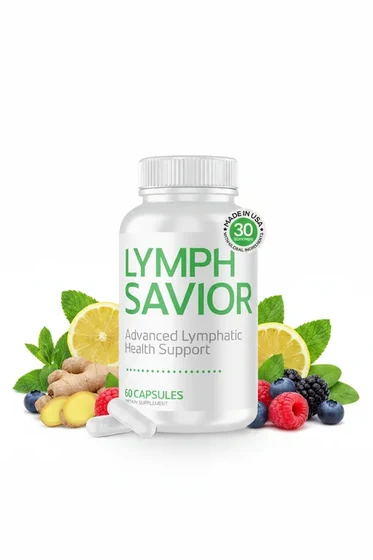
Food styling around a bottle is not a claim, and no one is pretending it is. It works anyway, and the check takes two seconds: read the ingredient list, then look at the photograph, and notice everything in the photograph that is not on the list.
Questions
Lymph Savior FAQ: testing and quality questions
What do the ten seals mean?
Between them: a process standard, a factory filing, two absence claims, a sourcing claim, a naturalness claim, a vegetarian claim that the label’s gelatin capsule does not support, an unnamed clinician, a country-of-origin mark with a typo in it, and a seller’s guarantee. None of them is an approval of the formula.
Which seal has a typo?
The blue country-of-origin roundel. It reads “MANUFACTURE IN USA” along the top and “MANUFACTURE IN” along the bottom. The verb is wrong in both halves.
What does “Doctor formulated” mean here?
It is a claim about who formulated the product, and nothing about it can be checked: no formulating clinician is named on the label or in the seller’s material. It is unrelated to this site’s medical reviewer, who reviews these pages and formulated nothing.
Does “Registered FDA Facility” mean FDA approves it?
No. It means a factory has filed its existence with FDA. FDA: “FDA does not have the authority to approve dietary supplements before they are marketed.”
Why is the photograph with the berries on this site?
Because it is evidence. The photograph stages the bottle with lemon, ginger, mint, raspberries, blueberries and blackberries, and only the ginger is on the label; lemon, mint and the three berries are not. It is published with that caption attached wherever it appears.
References
Sources for this page
- U.S. Food and Drug Administration. Questions and Answers on Dietary Supplements. www.fda.gov. Accessed September 24, 2026.
- NIH Office of Dietary Supplements. Dietary Supplements: What You Need to Know. ods.od.nih.gov. Accessed September 24, 2026.
- National Center for Complementary and Integrative Health. Dietary and Herbal Supplements. www.nccih.nih.gov. Accessed September 24, 2026.
- National Center for Complementary and Integrative Health. Using Dietary Supplements Wisely. www.nccih.nih.gov. Accessed September 24, 2026.
Next
Keep reading
Lot numbers and certificates of analysis
What a lot number proves, and what a certificate reference does not.
Read it →The Supplement Facts panel, line by line
All eleven lines as the label prints them, each with its own amount in mcg.
Read it →Three cards, three ingredient lists
Each card names six of the label’s eleven botanicals; three appear on all three.
Read it →See Lymph Savior pricing and the 60-day window
Sixty capsules a bottle, two a day with a glass of water, so one bottle lasts a month. Eleven botanicals, each printed with its amount on the Supplement Facts panel; the live price and the money-back window are shown at checkout.
Price shown at checkout · 60-day window from the date of purchase · ships from inside the US