Lymph Savior blog
Three Lymph Savior Cards, One Label
Each Lymph Savior marketing card names six plants and the printed label names eleven. When a seller’s artwork disagrees with itself, the label is the source of truth, and here it settles the question.
The finding
Three cards, one label
Three images in the seller’s artwork set out what is in the capsule. They are the kind of image a buyer reads quickly and trusts without noticing that they have trusted it, and on this product they give three different answers.
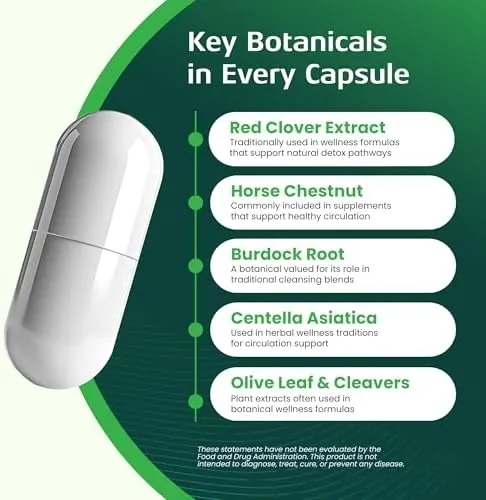
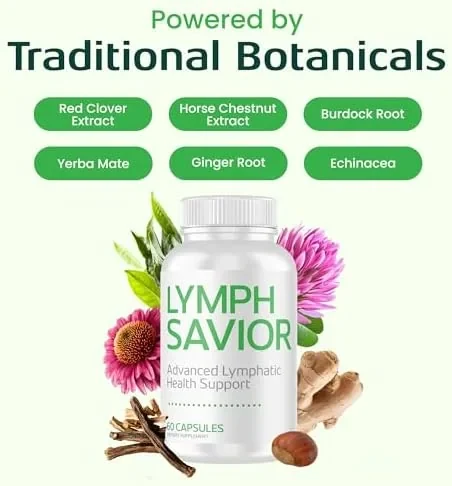
The card headed “Inside Lymph Savior — six named ingredients” lists red clover, horse chestnut, red root, Centella asiatica, burdock and yerba mate, and the “How Lymph Savior Works” card repeats that same six. The square headed “Key Botanicals in Every Capsule” keeps red clover, horse chestnut, burdock and Centella asiatica and names olive leaf and cleavers instead of red root and yerba mate. The square headed “Powered by Traditional Botanicals” keeps red clover, horse chestnut, burdock and yerba mate and names ginger root and echinacea instead of red root and Centella. Ten botanicals across three cards, and only red clover, horse chestnut and burdock on all three.
Taken on their own, the cards leave a reader guessing which list is the formula. The label does not. The full label artwork on the brand’s own storefront, read by this desk on September 26, 2026, prints a Supplement Facts panel of eleven botanicals, each with its own amount. Every plant on every card is on it. So is one more, stillingia, which no card names. The cards were never rival formulas. They are three six-name selections from one eleven-line label.
11 printed, 10 on cards
Eleven label lines, and which cards name each
Side by side, with the label added as the last word, the picture is easier to see than to describe.
| Botanical | On the label, per two-capsule serving | “Inside Lymph Savior” | “Key Botanicals in Every Capsule” | “Powered by Traditional Botanicals” | Cards |
|---|---|---|---|---|---|
| Red Clover | Line 1 · extract, leaves and flowers · 225 mcg | Named | Named | Named | 3 of 3 |
| Horse Chestnut | Line 2 · seed extract, std. to 20% aescin · 200 mcg | Named | Named | Named | 3 of 3 |
| Red Root | Line 3 · powder · 210 mcg | Named | — | — | 1 of 3 |
| Centella asiatica | Line 4 · extract, aerial parts · 125 mcg | Named | Named | — | 2 of 3 |
| Burdock | Line 5 · powder, root · 100 mcg | Named | Named | Named | 3 of 3 |
| Yerba Mate | Line 6 · Ilex paraguayensis extract, leaves · 100 mcg | Named | — | Named | 2 of 3 |
| Stillingia | Line 7 · Stillingia sylvatica extract, root · 100 mcg | — | — | — | 0 of 3 |
| Olive Leaf | Line 8 · extract, 20% oleuropein · 75 mcg | — | Named | — | 1 of 3 |
| Cleavers | Line 9 · Galium aparine extract, whole herb · 75 mcg | — | Named | — | 1 of 3 |
| Ginger Root | Line 10 · powder, root · 50 mcg | — | — | Named | 1 of 3 |
| Echinacea | Line 11 · Echinacea purpurea powder, leaf, stem and flower · 25 mcg | — | — | Named | 1 of 3 |
Card columns are read off the three marketing images and the label column off the full label artwork; the rows follow the label’s printed order. The cards print no amounts. The label prints one for every line, each in micrograms (mcg), and this post copies the unit as printed.
The union, the intersection, and the label
The union — everything named on any card — runs to ten. The intersection — everything named on every card — runs to three. Judged by the artwork alone, the seven botanicals between those numbers were the open question, because whether each was in the capsule seemed to depend on which image you happened to look at. The label answers it for all seven and adds an eleventh. The written copy this desk first worked from agreed with the “Inside” card, which turned out to be a fair guide to the top six lines of the panel and no guide at all to the five below them.
The strongest wording
The card that says in every capsule
Wording is not decoration, and one of these cards is worded more strongly than the other two. It is headed “Key Botanicals in Every Capsule”. Read that as a sentence rather than a headline: in every capsule is an absolute claim about the contents of every unit in every bottle. And it is the card that introduces olive leaf and cleavers, which appear on no other card, while leaving out red root and yerba mate.
Against the artwork alone, that looked like the strongest wording on the least corroborated list. Against the label it looks different. Olive leaf and cleavers are printed there as lines eight and nine, at 75 mcg each per serving, and the other four plants on the card are lines one, two, four and five. Every name on the card that makes the strongest claim is on the label. What it shares with the other two cards is only that it names six of the eleven.
That is the useful turn in this story. The disagreement looked like a question about the formula and was only ever a question about the artwork. The rule worth keeping is smaller than the finding: when two pieces of a seller’s own artwork disagree about what is in a product, the artwork is not the source of truth, and you should go and find the one that is.
The third card
The card that stages a rhizome and a flower
The third card is headed “Powered by Traditional Botanicals” and it does something the other two do not. It introduces ginger root and echinacea, and then stages the bottle beside a ginger rhizome and an echinacea flower, so that the two newest names on the list are also the two most visible objects in the picture. It leaves out red root and Centella asiatica in the same breath.
Both plants are on the label, as its last two lines and its two smallest amounts: ginger powder at 50 mcg and echinacea purpurea powder at 25 mcg per serving. The card is accurate about what is in the capsule; what a photograph cannot carry is proportion.
Why a photographed plant is persuasive
A plant photographed next to a bottle does not claim anything, and no one is pretending it does. It works anyway. What a reader leaves with is not a list of names but a picture of a capsule full of ginger and echinacea, and only the panel shows how much of each there is.
Five steps
The method, on any product
None of this is specific to one brand, and the useful part is the part you can carry to the next product. Five steps, about five minutes.
1. Count the ingredients on every image, not the best one
Open every image the seller supplies and write down the list on each. Sellers rarely intend a contradiction; they commission artwork at different times from different people, and the contradiction arrives on its own.
2. Note which wording is absolute
In every capsule, contains and made with are claims about contents. Inspired by, traditional and featuring are softer, and a card headed with a soft phrase can name a plant without quite saying it is in the bottle.
3. Build the union and the intersection
The union is everything named anywhere; the intersection is everything named everywhere. If the two match, the marketing is at least internally consistent. If they do not, the distance between them measures how much of the ingredient list is decoration.
4. Check whether the text matches any one image
Written copy is usually drafted from a real specification, so find out which image it agrees with. That card is the likeliest to be current — a tiebreak rather than a source.
5. Go and find the document that settles it
Which on any supplement is the Supplement Facts panel, plus the other-ingredients line beneath it. That block outranks every piece of artwork on the page, because it is the part that has to be true in a measurable way. If the seller cannot produce a photograph of it, you have not failed to find the answer; you have found it. On this product it is published with the full label artwork on the brand’s own storefront.
Label lines 7 to 11
What the federal record holds on lines seven to eleven
One more thing is worth doing with the five label lines the “Inside” card leaves out — stillingia, olive leaf, cleavers, ginger and echinacea — and it costs nothing: look each one up on a federal consumer site and see whether a page exists at all.
Ginger has an NCCIH page, and it reports a genuine finding: “Research shows that ginger may be helpful for nausea and vomiting associated with pregnancy.” That is about nausea in pregnancy, which has nothing to do with what this product is sold for.
Echinacea has one too, carefully hedged: “Taking echinacea may slightly reduce your chances of catching a cold. It’s still unclear whether echinacea can shorten the length of a cold. More research is needed to confirm these findings.” A cold is not the lymphatic system either.
The same page warns of allergic reactions, which may be severe, and lists caffeine among possible interactions; yerba mate, line six of this label, contains caffeine in an amount the label does not give.
Olive leaf, cleavers and stillingia are a different case: this site found no consumer page for any of the three on NCCIH, at NIH’s Office of Dietary Supplements or on MedlinePlus. That is not evidence against any of them. It means a buyer who wants to read something authoritative before swallowing them has, as far as this desk could find, no federal page to turn to, and is better served taking the label to a pharmacist or doctor.
The limit
What this does not say
This says nothing about whether the capsules are safe
A disagreement between three pieces of artwork is a fact about a marketing department. It is not a finding about a formula, and the label is not a verdict on safety either: it says what is in the capsule and how much, not whether the capsule suits you. No one outside the building can see the powder from here, and pretending otherwise would be the kind of reasoning this post argues against.
What the cards do is set a discount rate. Every statement on them comes off the same production line, so a reader who has just watched three of them name different sixes has good reason to move the weight onto what can be checked: the panel, the serving instruction, the arithmetic that follows, the claim on the front and the disclaimer beneath it. The document that ends the argument is the Supplement Facts panel, and on this product it is published. The checkout page shows only the front of the bottle, so compare the panel on the bottle you receive with the one reproduced on this site’s Supplement Facts page, and go by the bottle if the two differ.
References
Sources
- National Center for Complementary and Integrative Health. Ginger: Usefulness and Safety. www.nccih.nih.gov. Accessed September 24, 2026.
- National Center for Complementary and Integrative Health. Echinacea: Usefulness and Safety. www.nccih.nih.gov. Accessed September 24, 2026.
- NIH Office of Dietary Supplements. Botanical Dietary Supplements: Background Information. ods.od.nih.gov. Accessed September 24, 2026.
- National Center for Complementary and Integrative Health. Using Dietary Supplements Wisely. www.nccih.nih.gov. Accessed September 24, 2026.
- U.S. Food and Drug Administration. Questions and Answers on Dietary Supplements. www.fda.gov. Accessed September 24, 2026.
Order Lymph Savior from the official page
The three cards name ten plants; the label names eleven, with an amount for each. Two capsules a day, thirty servings a bottle, and the live price at checkout.
Price is shown at checkout · 60 days from the date of purchase · ships from inside the US
Next
Keep reading
The label and all three cards
Every card list set against the eleven printed lines of the Lymph Savior panel, stillingia included.
Read it →The method, written out in full
What to do when two pieces of a seller’s own artwork name different ingredients.
Read it →What the Lymph Savior Label Actually Prints
The eleven-line Supplement Facts panel read in printed order, with the other ingredients, the caution and the distributor.
Read it →