Lymph Savior blog
What the Lymph Pages Actually Say
Every figure and definition below is quoted from a federal page. Read them in order and the gap between the literature and the marketing draws itself.
Definitions first
What the lymphatic system is
This post does something narrow. It reads the federal pages on the lymphatic system in order and quotes them. Every figure and every definition below is taken verbatim from MedlinePlus or from NCCIH.
Start with what the system is. MedlinePlus describes a network rather than an organ. It carries “Lymph - a fluid that contains white blood cells that defend against germs” through vessels, past nodes spaced along them. On the nodes: “Lymph nodes are present throughout your body. They are an important part of your immune system.”
Its job is put in one sentence: “The lymphatic system clears away infection and keeps your body fluids in balance.” And what happens when it fails is put in one more: “If it’s not working properly, fluid builds in your tissues and causes swelling, called lymphedema.”
Two things follow before any product is mentioned. This system is part of how the body fights infection, and part of how the body manages fluid — both big, slow, structural functions, which is worth holding onto while reading anything marketed at them.

The condition
Lymphedema, and what causes it
The condition named in that last sentence has its own MedlinePlus page, and it opens with a definition: “Lymphedema is the name of a type of swelling. It happens when lymph builds up in your body’s soft tissues.”
That is a specific thing — not a vague heaviness, but a type of swelling with a mechanism behind it. The page lists what causes it: infection; cancer; scar tissue from radiation therapy or the surgical removal of lymph nodes; and inherited conditions in which lymph nodes or vessels are absent or abnormal.
Read that list again, because it is the part the marketing around this category never quotes. Every item on it is either a serious diagnosis, the aftermath of treating one, or something a person was born with. Not one is a lifestyle state that accumulated over a winter and could be cleared out. The encyclopaedia entry on lymphatic obstruction adds the most ordinary cause of the mechanical version: “The most common reason for lymphatic obstruction is the removal or enlargement of the lymph nodes.”
4 treatments
What treats it: four things, none a capsule
Then the treatment line, which is the most useful sentence on the page and worth quoting in full:
MedlinePlus, on treating lymphedema
“Treatment can help control symptoms. It includes exercise, compression devices, skin care, and massage.”
Four things. Exercise. Compression devices. Skin care. Massage. Not one of them is a capsule, a powder or a drink. The entry on lymphatic obstruction adds compression wrapping, manual lymph drainage and range-of-motion exercise, and those are not capsules either. Every intervention in the federal literature for this system is mechanical: something that moves, compresses or protects the body.
That is not a hostile reading of the page. It is the page. A reader arriving at a lymph supplement because something is swelling has arrived at the wrong shelf, and the four words above are where the literature sends them instead.
A pair of hands
What manual lymph drainage actually is
One phrase from that list has been borrowed by the supplement category so thoroughly that it has come loose from its meaning. Lymphatic drainage appears on bottles, on landing pages and in product names, generally implying that something swallowed will perform it. MedlinePlus says what it is:
MedlinePlus, on manual lymph drainage
“Manual lymph drainage is a light massage therapy technique. During the massage, the skin is moved in certain directions based on the structure of the lymphatic system.”
A light massage technique. Performed on the body, on the skin, in directions chosen from the structure of the lymphatic system underneath. It is a pair of hands and a trained technique, and there is no version of it that happens inside a capsule.
That is not an argument that a botanical can do nothing at all. It is narrower and harder to dispute: the phrase the marketing borrows already means something specific in the federal literature, and the thing it means is not what a capsule does.
The category
The cleanse category, and what NCCIH says
Next door sits the category this site is published on the edge of. NCCIH has a consumer page on it and opens by describing what is being sold: “A variety of “detoxification” diets, regimens, and therapies—sometimes called “detoxes” or “cleanses”—have been suggested as ways to remove toxins from your body, lose weight, or promote health.”
Its finding is one sentence: “A 2015 review concluded that there was no compelling research to support the use of “detox” diets for weight management or eliminating toxins from the body.” And the gap behind the finding is one more: “There have been no studies on long-term effects of “detoxification” programs.”
Be fair about how that applies here. The word cleanse is not on this bottle, not in the claim and not in the supplied marketing copy — it is in the web address, one level up from anything that has to be substantiated. NCCIH closes its page with advice rather than a verdict: “Take charge of your health—talk with your health care providers about any complementary health approaches you use, including any “detoxes” or “cleanses.””
Being exact
The gap, and the one positive finding
So here is the honest position, without hedging in either direction. Nothing on NCCIH, at NIH’s Office of Dietary Supplements, on MedlinePlus or at FDA supports a botanical dietary supplement for lymphatic support, lymphatic drainage or a lymph cleanse. Not a positive finding, and not a negative one: no federal consumer page evaluates the idea at all. Of the eleven botanicals printed on this product’s label, this site found a federal consumer page for four — red clover, horse chestnut, ginger and echinacea — and none for the other seven.
The one finding near the claim, and what it is about
Two ingredients on this label have findings of their own on NCCIH: ginger, on nausea in pregnancy, and echinacea, on colds. Neither subject is the lymphatic system. Only one finding on this label’s ingredients sits anywhere near the claim, and it deserves to be stated plainly because it is real. NCCIH, on horse chestnut: “A 2012 systematic review of 17 studies suggested that horse chestnut seed extract can improve symptoms of CVI.” And: “Results from one of these studies suggested that horse chestnut seed extract may be as effective as wearing compression stockings.”
That is a genuine result from a systematic review. Three things have to be said in the same breath. CVI is chronic venous insufficiency, a disorder of the veins in the legs — the venous system and the lymphatic system are different systems, and a finding about one is not a finding about the other. The finding attaches to standardised seed extract, and on that point the label is specific: its second line is a horse chestnut seed extract standardised to 20% aescin. What no page can say is what this formula does, because no trial of it has been published; the research used standardised seed extract, not this capsule. The strongest card in this hand is real, and it is about veins.
Closing
When swelling is a clinician’s question
The practical end of this is short. Swelling that does not go down, swelling on one side, swelling that arrives with pain, fever or skin changes, and nodes that stay swollen — those are questions for a clinician, and MedlinePlus lists infection and cancer among the causes of both lymphedema and swollen lymph nodes.
FDA puts the cost of the alternative in one line: “Health fraud scams waste money and can lead to delays in getting proper diagnosis and treatment.” The money is the smaller half of that sentence. The delay is the part that matters, and it is why a page like this one should be blunt: if something is swelling, the capsule is not the first step.
What is fair to say about this product
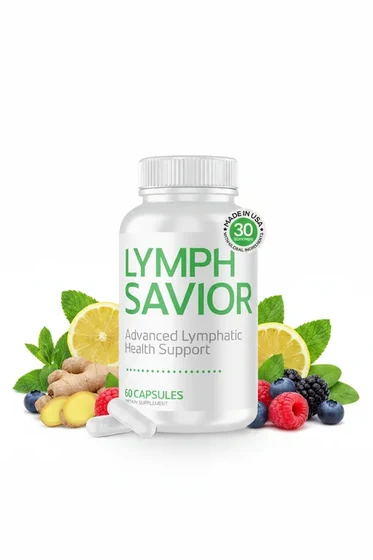
It makes a support claim rather than a treatment claim, and prints the FDA disclaimer in full on three of the supplied images. Its dose instruction is unambiguous and its arithmetic closes: 60 capsules, two a day, thirty servings, thirty days. None of that is nothing, and none of it is evidence for the lymphatic system either, because there is none to have. The full label, all eleven lines of it, is reproduced on this site’s Supplement Facts page; the checkout page shows only the front of the bottle, so compare that panel with the one on the bottle you receive.
References
Sources
- MedlinePlus, U.S. National Library of Medicine. Lymphatic Diseases. medlineplus.gov. Accessed September 24, 2026.
- MedlinePlus, U.S. National Library of Medicine. Lymphedema. medlineplus.gov. Accessed September 24, 2026.
- MedlinePlus Medical Encyclopedia. Lymphatic obstruction. medlineplus.gov. Accessed September 24, 2026.
- MedlinePlus Medical Encyclopedia. Swollen lymph nodes. medlineplus.gov. Accessed September 24, 2026.
- National Center for Complementary and Integrative Health. “Detoxes” and “Cleanses”: What You Need To Know. www.nccih.nih.gov. Accessed September 24, 2026.
- National Center for Complementary and Integrative Health. Horse Chestnut: Usefulness and Safety. www.nccih.nih.gov. Accessed September 24, 2026.
- U.S. Food and Drug Administration. Health Fraud Scams. www.fda.gov. Accessed September 24, 2026.
Order Lymph Savior from the official page
A support claim, eleven botanicals with printed amounts, two capsules a day. If swelling is the reason you are reading, see a clinician first; the price is shown at checkout.
Price is shown at checkout · 60 days from the date of purchase · ships from inside the US
Next
Keep reading
The claim and the federal record
What the lymphatic system does, and what an eleven-botanical capsule can and cannot be said to do.
Read it →Cautions, from the pages that have them
What NCCIH publishes on the four label ingredients that have a consumer page, and how to read the other seven.
Read it →What the Lymph Savior Label Actually Prints
Eleven botanicals, each with its own amount, plus the other ingredients, the caution and the distributor.
Read it →