Retail desk · licensed U.S. retail desk for Lymph Savior 11 botanicals · every amount on the label 60-day window from purchase two capsules a day

2 capsules a day · official information

Lymph Savior Official Website: 11-Botanical Capsules for Lymphatic Health Support

  • 11 botanicals
  • 11 amounts printed
  • 2 capsules a serving
  • 30 servings a bottle

1 minute answer

Lymph Savior is a dietary supplement capsule for lymphatic health support.

Use case: Adults take two capsules a day with 6 to 8 oz of water; each 60-capsule bottle holds 30 servings, about one month.

How it works: Eleven botanicals, led by red clover, horse chestnut seed and red root, each have their own printed amount and no proprietary blend, to support lymphatic health.

Licensed U.S. retail desk for Lymph Savior · orders go through the order buttons · the eleven-line label · six questions before you order

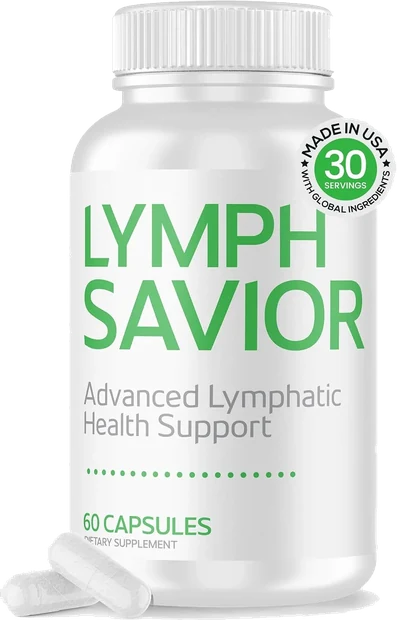
Lymph Savior lymphatic support capsules, white bottle of 60 capsules
Red Clover Extract — 225 mcg Leaves and flowers, the first line on the label. One of four botanicals here with an NCCIH consumer page, and NCCIH notes it may be unsafe in pregnancy or breastfeeding.
60capsules a bottle
2capsules a day
11botanicals, each with an amount
60day window from purchase
Accepted payment cards and wallets GMP certified mark Registered FDA facility mark Non-GMO mark Ten marks ship with the pack. What each one means

This pagePrepared at lymphsaviorcleanse.com by the Lymph Savior Editorial DeskMedical review: Dr. Carrie Lam, MD, PhysicianRevised Our editorial standards

Good Manufacturing Practice roundel seal
Good Manufacturing Practice
Registered FDA facility roundel seal
Registered FDA facility
Non-GMO certification mark seal
GMO free
Dairy free certification mark seal
Dairy free
100% satisfaction money-back roundel seal
Money-back guarantee

11 lines, each with an amount

What does the Lymph Savior label print on the back?

The back of the Lymph Savior bottle prints a Supplement Facts panel. The serving is two capsules, the bottle holds thirty servings, and eleven botanicals each have their own amount in micrograms, with no proprietary blend.

The back of the bottle carries the part a buyer can check: a Supplement Facts panel with eleven botanical lines.

Every dietary supplement sold in the United States carries a Supplement Facts panel. It prints the serving size, the number of servings in the container, each dietary ingredient by name and the amount of each one in a serving. The Lymph Savior panel does all of that. The serving is two capsules, the bottle holds thirty servings, and eleven botanicals follow, each on its own line with its own amount. Nothing is folded into a proprietary blend, so no ingredient hides behind a single total.

Two details are worth knowing before you read the numbers. Every amount is printed in micrograms (mcg), and this site copies each one in that unit exactly as the label prints it. And the order page shows only the front of the bottle, so the panel here was read from the full label artwork on the brand’s storefront on September 26, 2026. When your bottle arrives, turn it round and compare the two; if they differ, follow the bottle in your hand.

Not a proprietary blend

Eleven botanical lines and eleven separate amounts, plus two other ingredients: a gelatin capsule and brown rice flour. The label also states “No added: eggs, dairy, wheat, preservatives”.

Why the panel is the part that matters

A named ingredient with an amount beside it can be compared: with another product, with the same product next year, and with what published research describes. NIH’s consumer page on botanicals is candid about the limits: “Determining the quality of a botanical dietary supplement product from its label is difficult.” A printed amount does not tell you how well a plant works. It does tell you what the label says is in each serving, which is where every other question on this site starts.

2 capsules per serving

The Lymph Savior Supplement Facts panel, line by line

The Lymph Savior Supplement Facts panel lists eleven botanicals for a serving of two capsules, from red clover extract at 225 mcg down to echinacea at 25 mcg. This copy keeps the printed order and units.

Here is the panel as it is printed, in the printed order. The first tab is the back of the bottle; the second is everything the front prints. Red root sits third although its amount is larger than the line above it. That is how the label lists it, and this copy keeps the order rather than tidying it.

Supplement Facts

Serving size: 2 capsules · Servings per container: 30

  • Red Clover ExtractLeaves and flowers.225 mcg †
  • Horse Chestnut ExtractAesculus hippocastanum, seed, std. to 20% aescin.200 mcg †
  • Red Root PowderPrinted without a plant part.210 mcg †
  • Centella asiatica ExtractAerial parts.125 mcg †
  • Burdock PowderRoot.100 mcg †
  • Yerba Mate ExtractIlex paraguayensis, leaves.100 mcg †
  • Stillingia ExtractStillingia sylvatica, root.100 mcg †
  • Olive Leaf Extract20% oleuropein.75 mcg †
  • Cleavers ExtractGalium aparine, whole herb.75 mcg †
  • Ginger PowderRoot.50 mcg †
  • Echinacea purpurea PowderLeaf, stem, flower.25 mcg †

† Daily Value not established.

Other ingredients: gelatin (capsule), brown rice flour. Not a proprietary blend: every line carries its own amount.

Transcribed by this desk from the full label artwork, read September 26, 2026. The order page shows the front of the bottle only, so check this panel against the bottle you receive.

10 of 11 on a card

Why do the three Lymph Savior marketing cards list different ingredients?

Each of the three marketing cards names six plants, and every plant is one of the eleven on the Supplement Facts panel. The cards show a different six each, so they do not disagree with the label.

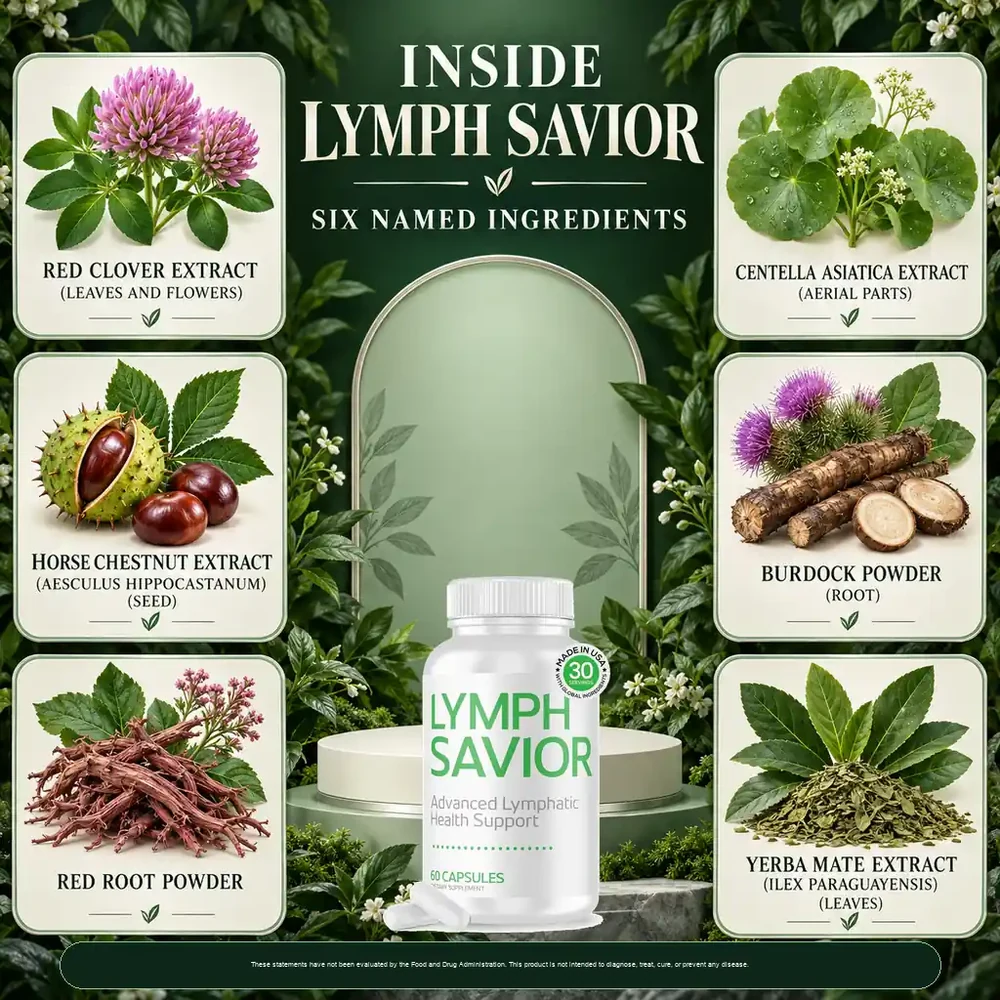
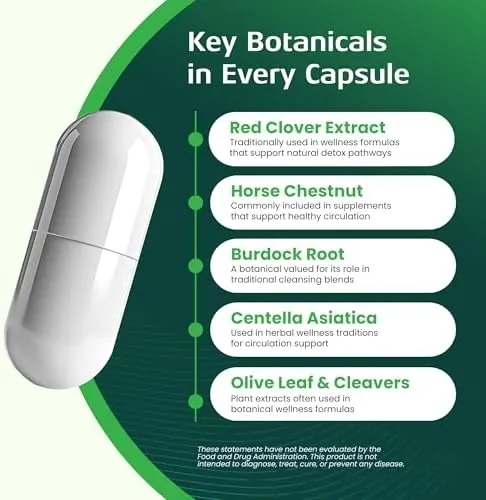
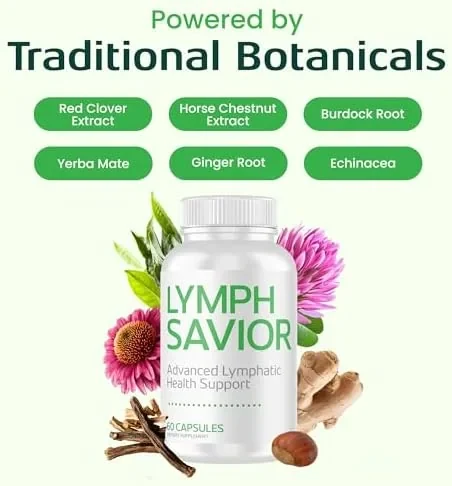
Three images in the seller’s pack each name six plants, and at first glance they seem to disagree. The label settles it: every plant on every card is one of the eleven on the Supplement Facts panel. The card headed “Inside Lymph Savior — six named ingredients” shows label lines one to six (red clover, horse chestnut, red root, Centella asiatica, burdock and yerba mate), and the “How Lymph Savior Works” card repeats them. The square headed “Key Botanicals in Every Capsule” swaps in olive leaf and cleavers, and the square headed “Powered by Traditional Botanicals” swaps in ginger root and echinacea. Between them the cards name ten of the eleven; stillingia is the one label line that no card shows.

Red CloverTrifolium pratense, leaves and flowers
Horse ChestnutAesculus hippocastanum, seed
BurdockArctium lappa, root
Centella asiaticaaerial parts, also called gotu kola
Yerba MateIlex paraguayensis, leaves
Red Rootusually Ceanothus americanus
Olive LeafOlea europaea, leaf, 20% oleuropein
CleaversGalium aparine, whole herb
Ginger RootZingiber officinale, root
EchinaceaEchinacea purpurea, leaf, stem, flower
StillingiaStillingia sylvatica, root: on the label, on no card

Press a card to see which of the eleven label botanicals it names. Red clover, horse chestnut and burdock are on all three; stillingia is on none.

How to read marketing that names fewer plants than the label

A card is a picture made to sell, and six names fit on a card more comfortably than eleven. None of these three shows a plant that the label leaves out, so none of them is wrong; each is a selection. The habit worth keeping is simple: when a seller’s artwork and its Supplement Facts panel differ, go by the panel, because it is the part of the package that has to list every dietary ingredient with its amount.

3 cards supplied

The three Lymph Savior cards, side by side

The three Lymph Savior cards shown side by side each name six of the eleven label botanicals. Between them they cover ten of the eleven, and stillingia is the one label line that no card shows.

All three supplied cards, side by side. Scroll sideways.

The “Inside Lymph Savior” card: six named ingredients around the bottle
The “Key Botanicals in Every Capsule” card, which names olive leaf and cleavers
The “Powered by Traditional Botanicals” card, which names ginger root and echinacea

Put them next to each other with the label beside them and the pattern is plain. The first card and the “How Lymph Savior Works” card show the first six lines of the panel. The second is the card that says “in every capsule”, and both plants it adds, olive leaf and cleavers, are printed on the panel. The third stages the bottle beside a ginger rhizome and an echinacea flower; ginger and echinacea are the last two lines of the panel, at 50 mcg and 25 mcg.

4 treatments MedlinePlus lists

What does Lymph Savior lymphatic support mean, and what do the federal pages say?

The front of the bottle claims Advanced Lymphatic Health Support. MedlinePlus describes the lymphatic system as a network of lymph, vessels and nodes that clears away infection and keeps body fluids in balance. A capsule claim is a support claim only.

The claim on the front of this bottle is Advanced Lymphatic Health Support, and the sales line is Move freely through each day. It is worth being precise about what the lymphatic system is before deciding what a capsule could do for it. MedlinePlus describes it as a network: lymph, a fluid carrying white blood cells; vessels that carry the lymph; and nodes along the vessels where those cells fight infection. Its job, in MedlinePlus’s own words, is that it “clears away infection and keeps your body fluids in balance”, and when it does not work properly “fluid builds in your tissues and causes swelling, called lymphedema”.

What the federal pages say treats a lymphatic problem

Here is the part worth knowing before you buy anything for swelling. MedlinePlus lists what causes lymphedema — infection, cancer, scar tissue from radiation therapy or the surgical removal of lymph nodes, and inherited conditions where nodes or vessels are absent or abnormal — and it lists what treats it: “Treatment can help control symptoms. It includes exercise, compression devices, skin care, and massage.” Four things, and none of them is a capsule. The encyclopaedia entry on lymphatic obstruction adds compression wrapping, manual lymph drainage and range-of-motion exercise — and is explicit that manual lymph drainage is “a light massage therapy technique” performed on the body. The phrase is borrowed by supplement marketing constantly. In the federal literature it describes a pair of hands.

And what they say about supplements for it

Nothing on any of the four federal sites this page cites supports a botanical supplement for lymphatic support, lymphatic drainage or a lymph cleanse. NCCIH’s own research-priorities page concedes that “significant knowledge gaps remain in evaluating whether many other complementary approaches… may also modulate the lymphatic system” — which is the agency describing an open question, not a settled one. If you have swelling that will not go down, MedlinePlus’s list is where to start, and it starts with a clinician.

6 phrases, 4 questions each

Lymph Savior claims: six packaging phrases, translated

Six phrases from the Lymph Savior packaging and web address are each checked for where they appear, what they may mean and what the federal record shows. None of them is an approval of the formula.

Six phrases from this product’s packaging and web address, each one put through the same four questions: where does it appear, what is it allowed to mean, what does the federal record show, and what should a reader do with it.

Where it appears

What it is allowed to mean

What the federal record shows

What to do with it

11 dossiers

Lymph Savior ingredients: the eleven botanicals and their amounts in mcg

The Lymph Savior ingredients list has eleven botanicals: red clover, horse chestnut seed, red root, Centella asiatica, burdock root, yerba mate, stillingia, olive leaf, cleavers, ginger root and Echinacea purpurea. Each has its own amount in micrograms.

Eleven dossiers, in the order the panel prints them. Each card carries the printed amount per two-capsule serving on its face and what the federal record says on its back. The amounts are copied in micrograms, as printed.

225 mcg per serving

Red Clover Extract

Trifolium pratense, leaves and flowers

The first line on the panel and its largest amount. A legume whose flowers and leaves carry isoflavones.

Tap to turn

NCCIH page

Red Clover Extract

Studies for hot flashes have given inconsistent results; NCCIH describes use for up to two years with apparent safety.

NCCIH says red clover may be unsafe in pregnancy or breastfeeding, and its isoflavones are structurally similar to estrogen, which is worth raising with a clinician if that matters in your history.

Tap to turn back

200 mcg per serving

Horse Chestnut Extract

Aesculus hippocastanum, seed, standardized to 20% aescin

The botanical with the most research behind it, and the label names the standardized seed extract that research used.

Tap to turn

NCCIH page

Horse Chestnut Extract

A 2012 systematic review suggested seed extract can improve symptoms of chronic venous insufficiency — a vein condition, not a lymphatic one.

Side effects NCCIH names: dizziness, digestive upset, headache and itching. The raw seed, bark, flower and leaf are unsafe to swallow, and little is known about use in pregnancy or breastfeeding.

Tap to turn back

210 mcg per serving

Red Root Powder

Ceanothus americanus, usually; the label prints no species

Printed third on the panel, below horse chestnut, although its amount is larger.

Tap to turn

No federal page found

Red Root Powder

This site found no NCCIH, NIH ODS or MedlinePlus consumer page for red root.

No federal page means no federal caution and no federal reassurance. Treat it as unknown and name it to your clinician with the rest of the label.

Tap to turn back

125 mcg per serving

Centella asiatica Extract

Centella asiatica, aerial parts

Better known as gotu kola, and widely sold for circulation.

Tap to turn

No federal page found

Centella asiatica Extract

This site found no federal consumer page for Centella asiatica.

The general rule applies: NCCIH says supplements “may interact with your medications or pose risks if you have certain medical problems or are going to have surgery”.

Tap to turn back

100 mcg per serving

Burdock Powder

Arctium lappa, root

One of three plants shown on all three of the marketing cards.

Tap to turn

No federal page found

Burdock Powder

This site found no federal consumer page for burdock.

Nothing federal is published for burdock specifically, so there is no federal caution to quote.

Tap to turn back

100 mcg per serving

Yerba Mate Extract

Ilex paraguayensis, leaves

The one line here that carries caffeine, and the label does not state how much.

Tap to turn

No federal page found

Yerba Mate Extract

No federal consumer page for yerba mate itself, and it is the line that carries caffeine.

If you count caffeine for sleep, for a heart rhythm or because a clinician asked you to, treat this amount of caffeine as unknown.

Tap to turn back

100 mcg per serving

Stillingia Extract

Stillingia sylvatica, root

A root extract printed on the panel and shown on none of the three marketing cards.

Tap to turn

No federal page found

Stillingia Extract

This site found no federal consumer page for stillingia.

With nothing federal to read, the practical step is to name it, with the other ten, when you show the label to a clinician or pharmacist.

Tap to turn back

75 mcg per serving

Olive Leaf Extract

Olea europaea, leaf, 20% oleuropein

One of only two lines with a printed standardization.

Tap to turn

No federal page found

Olive Leaf Extract

This site found no federal consumer page for olive leaf extract.

The printed 20% oleuropein tells you how the extract is standardized; it does not tell you what it does at this amount.

Tap to turn back

75 mcg per serving

Cleavers Extract

Galium aparine, whole herb

A traditional herb, shown on the “Key Botanicals” card.

Tap to turn

No federal page found

Cleavers Extract

This site found no federal consumer page for cleavers.

Treat it as you would any botanical without a federal page: known by name, unknown by evidence.

Tap to turn back

50 mcg per serving

Ginger Powder

Zingiber officinale, root

The one food in the product photograph that is also on the label.

Tap to turn

NCCIH page

Ginger Powder

NCCIH has a consumer page on ginger; the research it describes concerns other uses, not the lymphatic system.

Familiar as a food, and the second smallest amount on the panel.

Tap to turn back

25 mcg per serving

Echinacea purpurea Powder

Echinacea purpurea, leaf, stem, flower

The last and smallest line on the panel.

Tap to turn

NCCIH page

Echinacea purpurea Powder

NCCIH notes that echinacea can cause allergic reactions, which may be severe, and digestive side effects.

It may also interact with some medicines, including immunosuppressants, so tell your prescriber you take it.

Tap to turn back

4 of 11 have an NCCIH page

Lymph Savior ingredients: how much federal information exists for each botanical

Four of the eleven Lymph Savior botanicals have an NCCIH consumer page: red clover, horse chestnut, ginger and echinacea. For the other seven, this site found no consumer page on NCCIH, NIH ODS or MedlinePlus.

Four of the eleven have a consumer page on NCCIH, the federal centre for complementary health: red clover, horse chestnut, ginger and echinacea. For the other seven, this site found no consumer page on NCCIH, NIH ODS or MedlinePlus. That is not a finding against them. It means a reader who wants something authoritative before swallowing them has little to go on.

Horse Chestnut ExtractNCCIH consumer page, and a 2012 systematic review of 17 studies
Red Clover ExtractNCCIH consumer page; results described as inconsistent
Echinacea purpurea PowderNCCIH consumer page; the research it covers is not about lymph
Ginger PowderNCCIH consumer page; the research it covers is not about lymph
Red Root PowderNo federal consumer page found
Centella asiatica ExtractNo federal consumer page found
Burdock PowderNo federal consumer page found
Yerba Mate ExtractNo federal consumer page found
Stillingia ExtractNo federal consumer page found
Olive Leaf ExtractNo federal consumer page found
Cleavers ExtractNo federal consumer page found

The bar measures how much a reader can find on a federal consumer page, not how well an ingredient works. A hatched bar means this site found no page, which is a statement about the reading, not about the plant.

The one row with a real finding behind it

NCCIH on horse chestnut: “A 2012 systematic review of 17 studies suggested that horse chestnut seed extract can improve symptoms of CVI.” And: “Results from one of these studies suggested that horse chestnut seed extract may be as effective as wearing compression stockings.” That is a genuine result and it deserves to be said plainly. Two things belong next to it. CVI is chronic venous insufficiency, a disorder of the veins in the legs, and the venous and lymphatic systems are not the same system. And while the label does name a seed extract standardized to 20% aescin, the form the research used, no trial of this formula has been published, so this site does not set the printed amount against research doses.

5 pieces of information

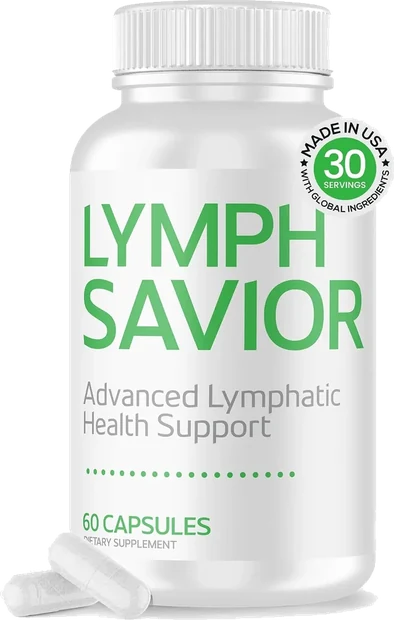
The front of the Lymph Savior bottle, point by point

The front of the Lymph Savior bottle shows the brand name, one support claim, a count of sixty capsules, the words dietary supplement and a Made in USA with global ingredients roundel. The ingredients and amounts are on the back.

Read the front of this bottle and count what is on it. A brand name. One support claim. A count. The words dietary supplement. A roundel that combines a country of manufacture, a sourcing caveat and a serving count in one mark. That is five pieces of information. The ingredients and their amounts are on the back, on the Supplement Facts panel, which is why the front-only picture on the order page never shows them.

The front of the Lymph Savior label, with eight points marked

Eight points on the bottle: six on the front, and two that live on the back panel, which is transcribed in full further up this page.

6 foods, 1 on the label

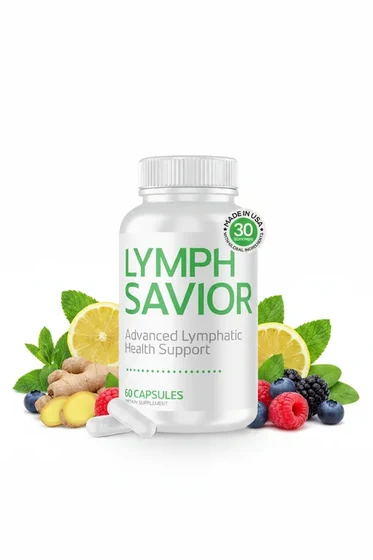
The Lymph Savior photograph, and which foods are on the label

A supplied Lymph Savior photograph shows the bottle with lemon, ginger, mint and berries. Only ginger is on the label, as ginger powder at 50 mcg per serving. Lemon, mint and the three berries are not ingredients.

One supplied photograph stages the bottle in a ring of sliced lemon, fresh ginger, mint, raspberries, blueberries and blackberries. Ginger is on the label, as ginger powder (root) at 50 mcg per serving, the second smallest line on the panel. Lemon, mint and the three berries are not ingredients at all. The photograph is published here because it shipped with the product, and it carries this caption wherever it appears.

The Lymph Savior bottle photographed in a ring of sliced lemon, fresh ginger, mint, raspberries, blueberries and blackberries
Supplied product photograph. Of the six foods shown, only ginger is on the label; lemon, mint, raspberry, blueberry and blackberry are not.

The two-second check

Food styling around a supplement bottle is not a claim and nobody is pretending it is. It works anyway. A reader who sees citrus and berries beside a capsule comes away with a sense of what is in the capsule, and on this product that sense would be right about one food in six. The check takes two seconds: read the ingredient list, then look at the photograph, and notice everything in the photograph that is not on the list.

2 capsules daily

How to take Lymph Savior: directions and dosage

Adults take two capsules daily with 6 to 8 oz of water, as the Lymph Savior label directs, or as directed by a healthcare professional. Two a day from a 60-capsule bottle lasts 30 days.

The label’s directions read, in full: “As a dietary supplement, adults take two (2) capsules daily. For best results, take with 6-8 oz of water or as directed by a healthcare professional.” Two capsules a day out of a bottle of sixty is thirty days, which matches the 30 SERVINGS roundel printed on the front of the bottle. That much is internally consistent and it is worth saying so before anything else on this page.

  1. Two capsules, once a day

    The instruction does not split them and does not name a time. If the yerba mate in this capsule matters to your sleep, morning is the cautious choice — and that is reasoning rather than instruction.

  2. With 6–8 oz of water

    About 180 to 240 millilitres, a small glass. The instruction specifies it, which is more than most capsule labels bother to do.

  3. Write down the date you paid

    The 60-day window runs from purchase, not from the first capsule. A parcel that sits unopened for a fortnight has spent a fortnight of it.

  4. Compare the panel on your bottle

    The order page shows only the front, so when the parcel arrives, turn the bottle round and check its Supplement Facts panel against the eleven lines on this site, including the gelatin capsule in the other-ingredients line.

  5. Decide by day 60

    One bottle finished a month ago. Two bottles finishes today. Three has a month left. Six has four sealed bottles left. Decide by the date, not by the bottle.

6 questions, doctor first

Lymph Savior pre-order check: six questions before you buy

Answer six questions before you order Lymph Savior. A yes to any of the first five, such as new one-sided swelling, pregnancy, a known medical condition or a prescription, means a clinician should hear about it before your first capsule.

Answer these before you order. A yes to any of the first five means a clinician should hear about Lymph Savior before your first capsule, and the panel underneath says what your answers add up to. The reasons are set out in the doctor-first section of the disclaimer.

Is the swelling new, in one arm or leg only, or painful, warm or red?

Have you had lymphedema, cancer treatment, radiation or lymph nodes removed?

Do you have heart, kidney or liver disease, or any other known medical condition?

Are you pregnant or breastfeeding, or under 18?

Do you take a water pill, a blood thinner or any other prescription medicine, or have surgery coming up?

Will you keep to two capsules a day and keep your order email?

Three more checks from the label

  • Dose. Two capsules a day is the serving the panel is written for, and the label says not to exceed it.
  • Caffeine and allergy. Yerba mate carries caffeine and the label does not say how much, so count it as unknown if you limit caffeine. If you have reacted to echinacea before, NCCIH notes that allergic reactions to it can be severe.
  • Paperwork. Keep the order confirmation email: its order ID starts any refund, and the money-back window is shown at checkout and on the guarantee page. When the parcel arrives, compare the panel on the bottle with the label on this site.

30 days a bottle

Lymph Savior cost per day: the supply arithmetic

One Lymph Savior bottle holds 60 capsules, and at two a day that is 30 days. A bottle price is therefore a monthly cost, a thirtieth of it is the cost of a day, and a sixtieth is one capsule.

The supply arithmetic is exact even when the price is not, and on this product it is unusually clean. Sixty capsules, two a day, is thirty days a bottle — and the front of the bottle prints 30 SERVINGS to confirm it. So a bottle price is a monthly cost, a sixtieth of it is the cost of one capsule, and a thirtieth of it is the cost of a day. Whatever number appears at the checkout, those three divisions turn it into something you can compare against anything else you buy monthly.

How long a pack lasts, and where the 60 days falls

60capsules in the pack
30 daysof product at that rate
Inside itwhere the last capsule falls
2 capsulesa day, as instructed

Where the sixty days falls

Set the window against the packs at two capsules a day. One bottle is 30 days — a month inside the window. Two bottles is 60 days — the product and the guarantee end on the same day, which is the neatest fit of the four. Three bottles is 90 days, so 30 days of product sit outside it. Six bottles is 180 days, and when the window shuts four bottles are still sealed. The pack the seller calls its top seller is the one where the guarantee expires with two thirds of the product unopened.

20 facts, label first

Lymph Savior at a glance

Lymph Savior is a dietary supplement in capsule form: a white bottle of 60 capsules, two capsules daily with 6 to 8 oz of water, 30 servings, and eleven botanicals with an amount on every line and no proprietary blend.

What the label and the seller’s pack state, in one table, with the label winning wherever the two differ.

Product
Lymph Savior, a dietary supplement
Sold by
Lymphsaviorcleanse, a licensed U.S. retail desk
Distributor
Lymph Savior, Akron, Ohio, printed on the label. No manufacturer is named.
Form
Capsule, in a white bottle
Count
60 capsules (front label)
Serving
2 capsules daily, with 6–8 oz of water
Servings per bottle
30 — so one bottle is 30 days
Supplement Facts panel
Printed. Eleven botanical lines, each with its own amount
Ingredients
11 on the label; each marketing card shows 6 of them
Amounts
225 mcg (red clover) down to 25 mcg (echinacea) per serving, printed in mcg
Proprietary blend
No. Every line carries its own amount
Capsule
Gelatin, with brown rice flour as the other ingredient
Caffeine
Present via yerba mate; the amount is not stated
Allergen line
“No added: eggs, dairy, wheat, preservatives”
Country
Made in USA with global ingredients (front roundel)
Claim on the front
Advanced Lymphatic Health Support
NCCIH consumer pages
4 of 11: red clover, horse chestnut, ginger, echinacea
Lot
LYM-26/LY-7378 (from the pack; not legible on any photograph)
Guarantee
60 days from purchase, per the supplied pack
Price
Shown at checkout

10 marks, 0 approvals

Lymph Savior seals and marks: what each one certifies

Ten marks ship with Lymph Savior, covering a process standard, a factory filing, absence claims, a sourcing claim and a seller guarantee. None of them is an approval of the formula.

Ten marks ship with this product. Between them they cover a process standard, a factory filing, two absence claims, a sourcing claim, a naturalness claim, a vegetarian claim, an unnamed formulator, a country of origin with the verb misspelled, and a seller’s guarantee. None is an approval of the formula. Two can now be checked against the printed label: GMP and non-GMO also appear as badges on the label itself, and the vegetarian roundel does not match a label that lists a gelatin capsule.

Good Manufacturing Practice roundel

Good Manufacturing Practice

A red roundel reads GOOD MANUFACTURING PRACTICE. GMP is a process standard about records, cleanliness and traceability. It says the capsules are made under documented procedures; it says nothing about whether the formula works. Process marks describe the factory, not the formula. The label repeats the claim as a “GMP facility” badge without naming who audits it.

Registered FDA facility roundel

Registered FDA facility

A blue roundel reads REGISTERED FDA FACILITY. Facility registration is a filing: the plant tells FDA it exists and what it does. It is not an approval of this product, of this formula or of anything printed on the bottle. FDA is explicit in its own consumer Q&A: “FDA does not have the authority to approve dietary supplements before they are marketed.”

Non-GMO certification mark

GMO free

A sourcing statement about the raw material, not a test result for the batch. The label’s own badge reads “Made with non-GMO ingredients”, and no certifying body is named on either.

100% natural ingredients roundel

100% natural ingredients

A green roundel reads 100% NATURAL INGREDIENTS. Eleven botanicals in a gelatin capsule is a reasonable thing to call natural, so this one is not stretched the way it is on some products. It is still not a safety statement, and NCCIH is direct about why: “‘natural’ does not always mean ‘safe.’ For example, the kava plant is a member of the pepper family but taking kava supplements can cause liver disease.” The sharper version of that point is on this very label: horse chestnut is entirely natural, and NCCIH says the raw seed is unsafe to swallow, which is why it matters that the label names a standardized seed extract.

Manufacture in USA star seal

“Manufacture in USA”

One of the ten marks has a typo in it, and it is the country-of-origin one. The blue roundel reads “MANUFACTURE IN USA” along its top and “MANUFACTURE IN” along its bottom — the verb is wrong in both halves and the second half does not finish its own sentence. The correct wording is manufactured in. It is not a safety problem and it tells you nothing about the capsule. It tells you the marks were assembled rather than awarded, which is the useful thing to know about a supplement seal.

Vegetarian roundel

Vegetarian

This is the one mark the label contradicts. The other-ingredients line reads “Gelatin (capsule), Brown Rice Flour”, and gelatin is made from animal collagen. If you avoid animal products, go by the label rather than the roundel, and ask the seller before you order.

Naturally gluten free roundel

Naturally gluten free

The word naturally is doing the work. It says the ingredients are not gluten-containing plants, which fits all eleven botanicals and the brown rice flour, and the label adds “No added: eggs, dairy, wheat, preservatives”. It is still not a test result.

Dairy free certification mark

Dairy free

Consistent with the label, which lists no dairy and says none is added. Like the gluten mark, it is a statement about what is absent rather than a test result.

Doctor formulated roundel

Doctor formulated

A black roundel reads DOCTOR FORMULATED. No formulating clinician is named on the bottle, on the cards or in the pack text: no qualification, no specialty, no institution. A named clinician can be looked up; an unnamed one is a claim with nothing attached. The physician named on this site reviews these pages, which is a different job from formulating the capsule.

100% satisfaction money-back roundel

Money-back guarantee

Sixty days from purchase per the supplied pack, unless the sales page prints a longer window. A seller’s promise rather than a regulator’s rule. Read it on the sales page before you pay and screenshot it with the date showing.

8 buyers, 3 sentences

Lymph Savior Reviews: how this site handles them

This site publishes no Lymph Savior customer reviews, star scores or order counts. The supplied pack calls its own review block layout copy, so printing it as testimony would mislead you.

We are not publishing the customer reviews supplied with this product, and the clearest reason is written in the supplied pack itself. Its final line reads: “Reviews, star scores, and order counts in this pack are layout copy only.” That is the seller’s own instruction to whoever builds the website, and it says the numbers are placeholders. Printing them as testimony after reading that sentence would mislead you, so they stay off this site.

Two things in the block confirm it on their own

Two things in the block confirm it on their own. First, the sentences repeat: eight named buyers share three sentences between them. Four of the eight say “Fair at a month. Wanted more in week one.” word for word. Two more share “Wanted a faster change. Called the desk. Stopped at two.” The last two share “Daily habit stuck. Reordered before the last bottle.” Second, all eight are men — Neil, Stan, William, Marcus, Chris, Tom, William and Sam — which is not what a sample of 1,104 written reviews looks like.

And the arithmetic does not close

The arithmetic does not quite close either. Weight the star split the block prints — 66% five-star, 21% four, 8% three, 3% two, 2% one — and it averages 4.46, which rounds to 4.5. The figure printed above it is 4.4. It is a small discrepancy and on its own it would mean little; sitting above a block that describes itself as layout copy, it is one more reason to treat the whole of it as furniture.

The seller’s figures, not ours

What the Lymph Savior listing publishes

4.4 / 5average score
1,104written reviews
8,347orders placed
90%say they recommend it
5 star66%
4 star21%
3 star8%
2 star3%
1 star2%

Those numbers come from the seller’s own material. We did not collect them, we cannot verify them, and no rating appears in this site’s structured data. Buyers are reported as liking the daily capsule and the 60-day window, and as disliking a slow start, and wanting more in week one; the most common wait before judging it is given as 4 to 8 weeks, and the most ordered pack as 6 bottles.

And what stays off this page

The block’s own last line is the reason this page quotes no review from it: “Reviews, star scores, and order counts in this pack are layout copy only.” The figures above are shown only as the seller’s, and no individual review is quoted.

How we source a fact

8 rows scored

Is Lymph Savior legit? How this desk scores it, row by row

This desk scores Lymph Savior 5.2 out of 10 across eight rows. Dose clarity scores 8.0 and label transparency 7.0, while evidence behind the formula scores 3.0 because no trial of this formula has been published.

Eight rows, scored by this desk against the label, the seller’s pack and the federal record. When the full panel was transcribed, two rows were re-scored on September 30, 2026: label transparency and ingredient consistency. The overall mark is the plain average of the eight.

5.2out of 10
Lymph Savior editorial score
Label transparency7.0/10
Ingredient consistency6.0/10
Evidence behind the formula3.0/10
Claim discipline6.5/10
Dose clarity8.0/10
Seals and marks3.5/10
Reviews1.5/10
Buying and returns6.0/10
How each mark was reached. A low mark is a fact about the label or the pack, not an opinion about the buyer.
What we scoredMarkWhy
Label transparency7.0/10The panel prints every one of its eleven botanicals with its own amount, it is not a proprietary blend, and the other ingredients, a caution and the distributor are all on the label. It loses marks because the amounts are printed in micrograms with no context, the caffeine is not stated, no manufacturer is named, and the order page shows only the front of the bottle.
Ingredient consistency6.0/10Each marketing card shows six of the eleven label botanicals and none shows a plant the label leaves out. The “Inside” card still calls itself “six named ingredients” for an eleven-line label, and stillingia appears on no card.
Evidence behind the formula3.0/10Four of the eleven have an NCCIH consumer page. The one positive review finding — horse chestnut seed extract for chronic venous insufficiency — is about veins, not lymph, and no trial of this formula has been published.
Claim discipline6.5/10The label claim is a support claim, correctly disclaimed, and the disclaimer is printed on three of the supplied images as well as the label. The word cleanse appears only in the domain name. Credit where it is due.
Dose clarity8.0/10Two capsules daily, with water, sixty in a bottle, thirty servings on the front roundel, and a panel serving line that agrees. The instruction is unambiguous and the arithmetic closes. This is the product’s strongest row.
Seals and marks3.5/10Ten marks, one with a typo in the verb, one claiming an unnamed formulating doctor, and a vegetarian roundel beside a label that lists a gelatin capsule.
Reviews1.5/10The supplied pack labels its own review block as layout copy. Eight named buyers share three sentences, all eight are men, and the printed average does not match the star split. Nothing from it is published here.
Buying and returns6.0/10A sales line, a website inbox, two named addresses, a 60-day window from purchase and a stated refund sequence. No price or carrier was supplied, and the label names a distributor in Akron, Ohio but no manufacturer.

8 / 8 for and against

Lymph Savior pros and cons: what we rate, and what we do not

Lymph Savior gets eight things right, led by a Supplement Facts panel that prints every botanical with its own amount and no proprietary blend. It also has eight weak points, including no published trial of the formula and no reviews that could be checked.

Eight things this product gets right, and eight it does not.

+What we rate

  • The Supplement Facts panel prints every one of its eleven botanicals with its own amount, and nothing sits inside a proprietary blend.
  • The dose instruction is unambiguous and the arithmetic closes: 60 capsules, two a day, 30 servings, 30 days a bottle.
  • The front-label claim is a support claim, the modest form FDA permits, and it carries the disclaimer.
  • The label prints a caution for pregnancy, nursing, under-18s and known medical conditions, plus storage and safety-seal lines.
  • Horse chestnut is named as a seed extract standardized to 20% aescin, the form NCCIH describes as likely safe for short-term use.
  • The country-of-origin roundel carries its own qualifier, with global ingredients.
  • A lot number and a certificate reference were both supplied.
  • The two-bottle pack lines up exactly with the 60-day window, which is a rare clean fit and worth knowing about.

−What we do not

  • Every amount is printed in micrograms, and the label gives no context for the unit; this site copies it as printed.
  • The order page shows only the front of the bottle, so the panel has to be checked when the parcel arrives.
  • Yerba mate contains caffeine, and the label does not state how much.
  • The label names a distributor in Akron, Ohio, but no manufacturer.
  • The vegetarian roundel in the seal set does not match a label that lists a gelatin capsule.
  • Seven of the eleven botanicals have no consumer page on NCCIH, NIH ODS or MedlinePlus, and the one positive federal finding is for a vein condition.
  • The supplied pack labels its own reviews, star scores and order counts as layout copy.
  • One of the ten seals has the verb wrong in both halves of the roundel.

3 / 6 for and against

Who is Lymph Savior for, and who should see a clinician first?

Lymph Savior fits three situations, such as readers who want every amount in writing. In six others, including new or one-sided swelling, pregnancy or a prescription, the better first step is a conversation with a clinician.

Three situations where it makes sense, and six where the better first step is a conversation with a clinician.

Someone who wants every amount in writing

The panel prints all eleven botanicals with their amounts, in micrograms, and nothing sits in a blend. If you like to know exactly what a capsule is said to hold, this label lets you, and the single bottle is thirty days at the smallest cost.

Someone taking it for the horse chestnut specifically

There is a real federal finding behind horse chestnut seed extract, and it is for chronic venous insufficiency rather than anything lymphatic. The label names a seed extract standardized to 20% aescin at 200 mcg per serving; take the label to a clinician and ask how that compares with what was studied.

Someone adding a botanical capsule to an otherwise settled routine

Two capsules a day with water is about as simple as a supplement routine gets, and the arithmetic on the bottle closes exactly. If your interest is in the habit rather than in a particular study, this is a straightforward product to take.

And who should talk to a clinician first

Anyone with swelling that will not go down

That is a reason to see a clinician, not to buy a capsule, and new swelling in one leg is a same-day question. MedlinePlus lists infection and cancer among the causes of lymphedema, and the treatments it names are exercise, compression devices, skin care and massage.

Anyone who is pregnant or breastfeeding

NCCIH says red clover supplements “may be unsafe for use during pregnancy or while breastfeeding”, and that “little is known” about horse chestnut seed extract in pregnancy. The label itself asks pregnant or nursing mothers to consult a physician first.

Anyone counting caffeine

Yerba mate contains caffeine and the label does not say how much. If you count caffeine for sleep, for a heart rhythm or because a clinician asked you to, this capsule adds an amount you cannot put a number on.

Anyone who avoids animal products

The label lists a gelatin capsule, and gelatin is made from animal collagen, so the vegetarian roundel in the seal set does not describe this capsule. Go by the label.

Anyone taking medication, or with surgery coming up

NCCIH: supplements “may interact with your medications or pose risks if you have certain medical problems or are going to have surgery”. The label names no particular medicine, so hand your pharmacist the whole eleven-line panel and mention any water pill or blood thinner.

Anyone buying it because of the word in the web address

NCCIH on the category: “A 2015 review concluded that there was no compelling research to support the use of ‘detox’ diets for weight management or eliminating toxins from the body.” To the product’s credit, the bottle does not say cleanse. The URL does.

12 weeks, the one published window

How long does Lymph Savior take to work? A timeline from what is published

No trial of the Lymph Savior formula has been published, so no results timeline exists. One bottle lasts 30 days at two capsules a day, and the 60-day window from the date of purchase gives time to judge it.

No trial of this formula has been published, so most of this table is about dates and bottles rather than results.

What is known, day by day
WhenWhat happensWhat is actually known
Day 1Two capsules with 6–8 oz of waterWrite the date you paid somewhere you will find it again. The 60-day window starts from that date, not from this capsule. If a caffeine-containing extract is a question for you, this is the day to notice how you sleep.
Week 1Nothing is known about week oneNo trial of this formula has been published, so there is no published expectation for the first week. The supplied pack’s own reviews complain about week one — and that same pack calls its reviews layout copy.
Day 30One bottle is finishedSixty capsules at two a day. This is the natural decision point and it sits a clean month inside the guarantee window. If you have not yet compared the panel on your bottle with the label on this site, do it before this point.
Day 60The guarantee closesWhatever pack you bought. One bottle finished a month ago; two bottles finish today; three bottles has a month left in it; six bottles has four sealed bottles left. Decide by the date, not by the bottle.
Week 12The edge of the horse chestnut evidenceNCCIH describes standardised horse chestnut seed extract as used safely in research “for up to 12 weeks”. Twelve weeks is 84 days. Past that point there is no published safety window to sit inside, for the one ingredient here that has one.

9 things worth knowing

Lymph Savior side effects and safety: cautions worth knowing first

The Lymph Savior label prints a caution rather than a list of side effects: do not exceed the recommended dose, and ask a physician first if you are pregnant, nursing, under 18 or have a known medical condition.

The label prints a caution; it does not list side effects. What follows is that caution, the federal record for the four ingredients that have one, and a plain note on the rest. The doctor-first list sets out when to see a clinician before starting.

The label’s own caution

Do not exceed the recommended dose. The label asks pregnant or nursing mothers, children under 18 and anyone with a known medical condition to consult a physician before using this or any supplement.

Four of the eleven have a federal page, and seven do not

Red clover, horse chestnut, ginger and echinacea have NCCIH consumer pages. For red root, Centella asiatica, burdock, yerba mate, stillingia, olive leaf and cleavers this site found none. That is not evidence against them; it means there is little federal material to read first.

The label names a standardized horse chestnut seed extract

NCCIH: “The raw seeds, bark, flowers, and leaves of horse chestnut are unsafe when used orally because they contain a toxic component.” Standardized seed extracts are described as likely safe for short-term use, and the label lists a seed extract standardized to 20% aescin.

The horse chestnut evidence runs to twelve weeks, and the largest pack runs to 180 days

NCCIH says standardised extracts “have been used safely in research studies for up to 12 weeks”, and lists dizziness, digestive upset, headache and itching as side effects. Six bottles at two capsules a day is 180 consecutive days.

Red clover contains compounds structurally similar to oestrogen

NCCIH: “Red clover contains substances called isoflavones that are structurally similar to estrogen.” The same page says red clover supplements “may be unsafe for use during pregnancy or while breastfeeding”.

Echinacea can cause allergic reactions

NCCIH notes that echinacea can cause allergic reactions, which may be severe, as well as digestive side effects. It is the last line on the panel, at 25 mcg per serving.

Yerba mate contains caffeine, and the label does not say how much

FDA cites 400 mg a day as an amount not generally associated with negative effects in healthy adults, and notes “wide variation in both how sensitive people are to the effects of caffeine and how fast they eliminate it from the body”. Without a figure on the label, this product cannot be counted toward that.

Supplements interact with medicines, and this label names none

NCCIH: “Dietary supplements may interact with your medications or pose risks if you have certain medical problems or are going to have surgery.” If you take a blood thinner or a water pill, name it when you show the label to your prescriber.

Swelling that will not go down is a reason to see somebody, not to buy a capsule

MedlinePlus lists new or worse swelling in only one leg among the reasons to call a provider right away, and lists infection and cancer among the causes of lymphedema. FDA notes that health fraud scams “can lead to delays in getting proper diagnosis and treatment”.

6 questions to ask

What the Lymph Savior label leaves for you to ask

The panel answers most label questions. Six remain, including how much caffeine the yerba mate adds, why every amount is in micrograms, who manufactures it and what the vegetarian roundel means when the capsule is gelatin.

The panel answers most of what a reader normally asks of a supplement label. Six questions remain, and each has a practical answer.

How much caffeine is in it

Yerba mate carries caffeine and the label gives no figure, so count it as unknown against the 400 mg a day FDA cites for healthy adults.

Why the amounts are in micrograms

Every line is printed in mcg. The label does not explain the unit; this site copies it as printed, and your bottle is the final word.

Who manufactures it

The label names its distributor, Lymph Savior of Akron, Ohio, and prints the distributor’s own phone line and email. It does not name a manufacturer.

What the vegetarian roundel means here

It is in the seller’s seal set, but the label lists a gelatin capsule. Go by the label.

Which medicines to mention

The caution covers pregnancy, nursing, under-18s and known medical conditions. It names no medicine, so show the panel to your prescriber.

What the order page shows

Only the front of the bottle. Compare the panel on the bottle you receive with the one on this site.

2 bottles is the exact fit

Lymph Savior price and packs: 1, 2, 3 or 6 bottles, live price at checkout

Lymph Savior comes in four packs of one, two, three or six bottles. Live prices are shown at checkout, and each bottle is 30 days at two capsules a day, so the two-bottle pack ends on the last day of the 60-day window.

Four pack renders were supplied, and the live prices are set on the sales page, so every figure below reads “shown at checkout” and the arithmetic does the rest.

Smallest pack

Single Bottle

60 capsules · 30 days

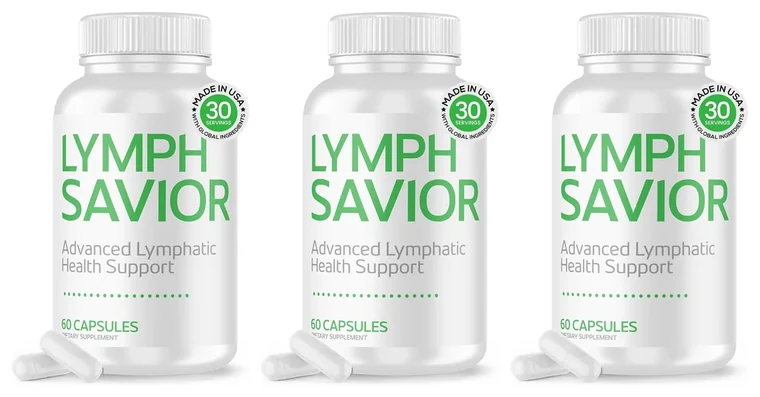
Lymph Savior single bottle, 1 white bottle of 60 capsules
Price at checkout live price on the sales page

30 days at two capsules a day

  • One bottle of 60 capsules
  • 30 days at two capsules a day
  • Finishes inside the 60-day window with a month to spare
  • The smallest order if you want to see the bottle and its panel first

Two months

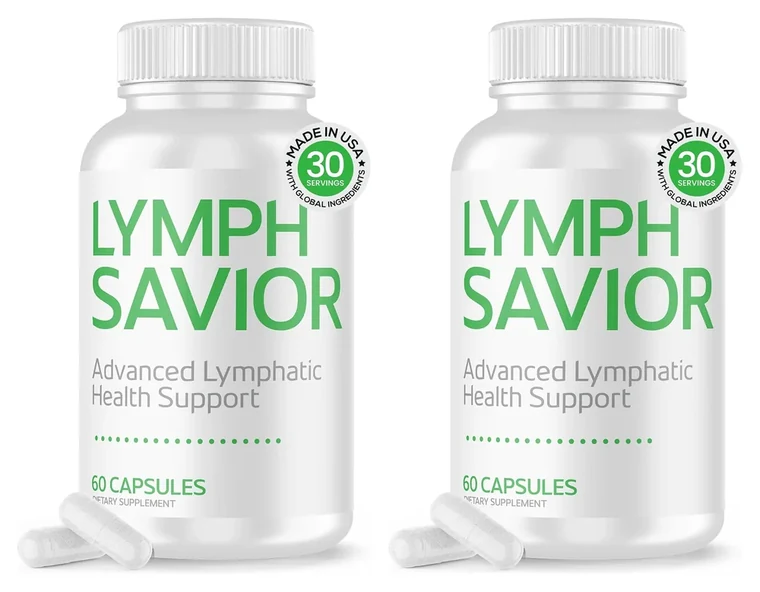
Two-Bottle Pack

120 capsules · 60 days

Lymph Savior two-bottle pack, 2 white bottles of 60 capsules
Price at checkout live price on the sales page

60 days at two capsules a day

  • Two bottles, 120 capsules in total
  • 60 days at two capsules a day
  • Ends exactly on the last day of the 60-day window
  • The only pack where the product and the guarantee run out together

Middle pack

Three-Bottle Pack

180 capsules · 90 days

Lymph Savior three-bottle pack, 3 white bottles of 60 capsules
Price at checkout live price on the sales page

90 days at two capsules a day

  • Three bottles, 180 capsules in total
  • 90 days at two capsules a day
  • 30 of those days fall outside the 60-day window
  • Longer than the twelve weeks NCCIH describes for horse chestnut extract

Top pack, per the seller

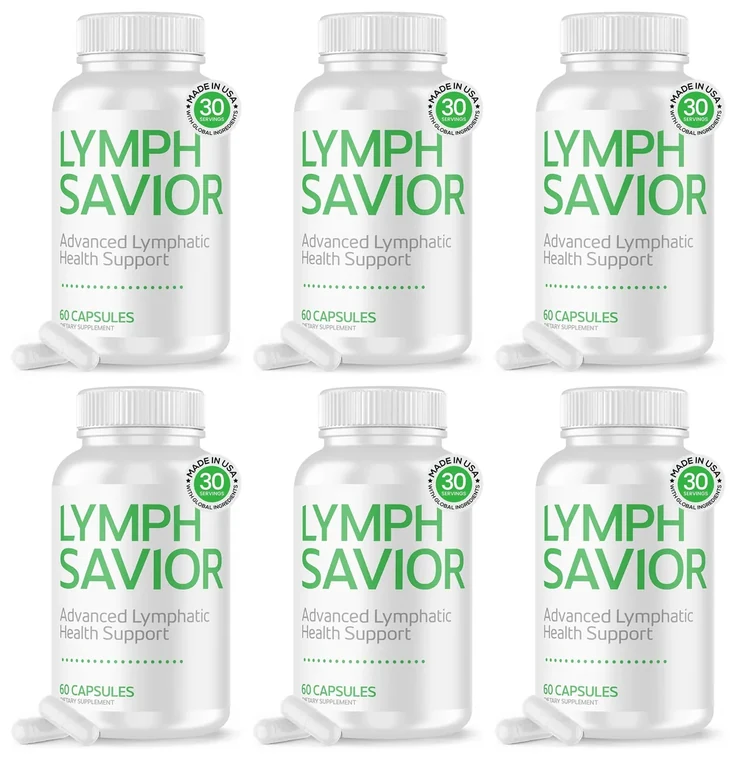
Six-Bottle Pack

360 capsules · 180 days

Lymph Savior six-bottle pack, 6 white bottles of 60 capsules
Price at checkout live price on the sales page

180 days at two capsules a day

  • Six bottles, 360 capsules in total
  • 180 days at two capsules a day
  • Four bottles are still sealed when the window closes
  • A long run for a formula with no published trial of its own

Every price on this site reads shown at checkout, because the live price is set on the sales page. The figure you will be charged is printed on the sales page and that is the only place it is binding. Read it before you pay, and screenshot the page with the total and the date showing.

60 capsules a bottle, two a day, thirty days Price shown at checkout · 60-day window from purchase
See pricing

2 named businesses

Lymph Savior For Sale: where to buy and who you are dealing with

Lymph Savior is for sale through the order buttons on this site, run by a licensed U.S. retail desk, not the maker. The price is shown at checkout, and there is a 60-day window from the date of purchase.

The desk’s own wording is “Licensed U.S. retail desk — Lymph Savior”. A retail desk sells the product and answers questions about orders. It does not make the capsules, it does not write the label and it is not the party that would hold a certificate of analysis. Questions about the formula belong with the distributor named on the label.

The order desk, and what it handles

Orders are placed with the order buttons on this site. After that, the order desk handles tracking, changes and refunds, and its number is listed in the site footer. It is not a formulation desk. The label prints a separate phone line and email for its distributor, Lymph Savior of Akron, Ohio. The website inbox, also in the footer, reaches this desk about pages, typos, privacy and press, and cannot see an order.

Before you call

Before you call, have the order ID, the email the order went to and the bottle itself in front of you, and ask one question at a time. What is in the capsule is answered on the label; the order desk is the place for delivery, changes and refunds.

Who makes it

The label says “Distributed By: Lymph Savior, Akron, OH 44301” and names no manufacturer. The front carries the brand name, the support claim, the count and the Made in USA with global ingredients roundel. The two New York addresses in the footer belong to this retail desk, not to the distributor or to whoever makes the capsules.

0 times on the bottle

Why “cleanse” appears only in this Lymph Savior web address

The word cleanse appears only in the web address, lymphsaviorcleanse.com. It is not on the Lymph Savior bottle, in its claim or in any supplied marketing copy, so the label makes no cleanse claim.

The domain this site is published on is lymphsaviorcleanse.com. The word cleanse is not on the bottle, it is not in the claim and it is not in any of the supplied marketing copy — it is in the web address, which is the one piece of the package nobody reads as a claim and everybody reads anyway. NCCIH has a consumer page on exactly this category, and its finding is one sentence: “A 2015 review concluded that there was no compelling research to support the use of ‘detox’ diets for weight management or eliminating toxins from the body.” The same page adds that “There have been no studies on long-term effects of ‘detoxification’ programs.”

And the fair half

To be fair to the product: the bottle does not say cleanse and the label claim it does make — support — is the modest one FDA permits. The word is doing its work in the URL, one level up from anything that has to be substantiated. That is worth naming once. Lymph Savior is not a detox or cleansing product, and nothing on this site describes it as one.

6 editorial rules

Who publishes this Lymph Savior information

The Lymph Savior Editorial Desk writes this information at Lymphsaviorcleanse, a retail desk, not the maker, and a physician reviews it for accuracy. The desk is paid when an order completes.

Six rules, and the first one is why this page has no customer quotes on it.

This site publishes no customer reviews and no star rating for Lymph Savior, because the supplied pack describes its own review block as layout copy.

No price is printed on this site; the live price is shown at checkout.

Every ingredient amount on this site is copied from the printed label, in the unit the label uses, and never converted.

Every federal quotation on this site was copied from a page opened and read on September 24, 2026, and every one is linked.

Where a supplied image contradicts the ingredient list, the image is published with the contradiction written underneath it rather than quietly cropped out.

This desk is paid when an order completes on the brand’s sales page. That is why these rules are written down, and the full method is on the editorial standards page.

18 federal pages

Sources for this Lymph Savior page

This Lymph Savior page cites eighteen federal reference pages, each opened and read on September 24, 2026. They include NCCIH pages on detoxes and cleanses and MedlinePlus pages on lymphedema and lymphatic diseases.

Eighteen federal reference pages, each opened and read on September 24, 2026.

  1. National Center for Complementary and Integrative Health. “Detoxes” and “Cleanses”: What You Need To Know. www.nccih.nih.gov. Accessed September 24, 2026.
  2. MedlinePlus, U.S. National Library of Medicine. Lymphedema. medlineplus.gov. Accessed September 24, 2026.
  3. MedlinePlus, U.S. National Library of Medicine. Lymphatic Diseases. medlineplus.gov. Accessed September 24, 2026.
  4. MedlinePlus Medical Encyclopedia. Lymphatic obstruction. medlineplus.gov. Accessed September 24, 2026.
  5. MedlinePlus Medical Encyclopedia. Swollen lymph nodes. medlineplus.gov. Accessed September 24, 2026.
  6. National Center for Complementary and Integrative Health. Horse Chestnut: Usefulness and Safety. www.nccih.nih.gov. Accessed September 24, 2026.
  7. National Center for Complementary and Integrative Health. Red Clover: Usefulness and Safety. www.nccih.nih.gov. Accessed September 24, 2026.
  8. National Center for Complementary and Integrative Health. Ginger: Usefulness and Safety. www.nccih.nih.gov. Accessed September 24, 2026.
  9. National Center for Complementary and Integrative Health. Echinacea: Usefulness and Safety. www.nccih.nih.gov. Accessed September 24, 2026.
  10. NIH Office of Dietary Supplements. Botanical Dietary Supplements: Background Information. ods.od.nih.gov. Accessed September 24, 2026.
  11. NIH Office of Dietary Supplements. Dietary Supplements: What You Need to Know. ods.od.nih.gov. Accessed September 24, 2026.
  12. National Center for Complementary and Integrative Health. Using Dietary Supplements Wisely. www.nccih.nih.gov. Accessed September 24, 2026.
  13. National Center for Complementary and Integrative Health. Dietary and Herbal Supplements. www.nccih.nih.gov. Accessed September 24, 2026.
  14. U.S. Food and Drug Administration. Questions and Answers on Dietary Supplements. www.fda.gov. Accessed September 24, 2026.
  15. U.S. Food and Drug Administration. Structure/Function Claims. www.fda.gov. Accessed September 24, 2026.
  16. U.S. Food and Drug Administration. 6 Tip-offs to Rip-offs: Don’t Fall for Health Fraud Scams. www.fda.gov. Accessed September 24, 2026.
  17. U.S. Food and Drug Administration. Health Fraud Scams. www.fda.gov. Accessed September 24, 2026.
  18. U.S. Food and Drug Administration. Spilling the Beans: How Much Caffeine is Too Much?. www.fda.gov. Accessed September 24, 2026.

18 questions

Lymph Savior FAQ: ingredients, side effects, price and where to buy

These answers cover what Lymph Savior is, its ingredients and amounts, side effects, FDA status, directions, caffeine, reviews, pregnancy, price and where to buy. The full FAQ page has more.

Fourteen of the questions readers ask most; the full FAQ page has eighty-one.

What is Lymph Savior?

Lymph Savior is a dietary supplement in capsule form, sold in a white 60-capsule bottle. The front label reads Advanced Lymphatic Health Support, and the Supplement Facts panel lists eleven botanicals with an amount for each. It is not FDA-approved.

What is on the Lymph Savior ingredients list?

Eleven botanicals, all on the Supplement Facts panel: red clover, horse chestnut seed, red root, Centella asiatica, burdock root, yerba mate, stillingia, olive leaf, cleavers, ginger root and Echinacea purpurea. Each line has its own amount in micrograms, with no proprietary blend.

Is Lymph Savior legit?

Lymph Savior is a dietary supplement with a fully listed label: eleven botanicals, an amount on every line and no proprietary blend. Orders go through the order buttons, the price is shown at checkout, and there is a 60-day window from the date of purchase.

Does Lymph Savior really work?

Individual results vary. No trial of this exact formula has been published, though four of its eleven botanicals have NCCIH consumer pages. Use it as the label directs, two capsules a day, and the 60-day window gives time to judge it.

How do I take Lymph Savior?

The label directs: as a dietary supplement, adults take two capsules daily. For best results, take with 6 to 8 oz of water or as directed by a healthcare professional. One 60-capsule bottle is 30 servings, so it lasts about 30 days.

What are the side effects of Lymph Savior?

Start with the label cautions. Yerba mate contains caffeine in an amount the label does not state, the capsule is gelatin, and pregnant or nursing mothers should consult a physician first. If you take a blood thinner or a water pill, show your prescriber the label.

Can I use Lymph Savior while pregnant or nursing?

The label asks pregnant or nursing mothers to consult a physician first. NCCIH says red clover may be unsafe in pregnancy or breastfeeding, and that little is known about horse chestnut seed extract then. The label also asks children under 18 to consult a physician.

Does Lymph Savior mix with water pills or blood thinners?

Ask your prescriber first. Show them the whole eleven-line label, and name the diuretic or blood thinner you take, such as hydrochlorothiazide or warfarin; blood thinners in particular can interact with foods, vitamins and supplements.

Is Lymph Savior FDA approved?

No. The FDA does not approve dietary supplements before sale, and Lymph Savior is sold as one. Its label lists eleven botanicals with an amount for each, which you can check on the bottle you receive.

What do Lymph Savior reviews and complaints say?

This site publishes no customer reviews, star scores or order counts, because none could be checked as real buyer reports. What you can check is the label: eleven botanicals, an amount on every line, and two capsules a serving.

Where can I buy Lymph Savior?

Lymph Savior is for sale through the order buttons on this site, run by the licensed U.S. retail desk for Lymph Savior. The price is shown at checkout, and there is a 60-day window from the date of purchase. Keep the order email, because its order ID starts any refund.

Is there a Lymph Savior money-back guarantee, and how do refunds work?

Orders have a 60-day window from the date of purchase. Keep the order email, because its order ID starts any refund. The order desk handles tracking, changes and refunds, and its number is listed in the site footer.

How many capsules are in a bottle of Lymph Savior?

A bottle holds 60 capsules. A serving is two capsules, so one bottle gives 30 servings, about a month at the label direction of two capsules a day.

What packs does Lymph Savior come in, and what do they cost?

Lymph Savior comes in four packs of one, two, three or six bottles. The live price is shown at checkout, and each bottle is 30 days at two capsules a day.

Where to order Lymph Savior: the official sales page

Order Lymph Savior through the order buttons on this site. The price is shown at checkout, there is a 60-day window from the date of purchase, and it ships from inside the US.

Two capsules a day with 6–8 oz of water, thirty servings a bottle, and a Supplement Facts panel that lists eleven botanicals with an amount on every line. Compare the panel on the bottle you receive with the one on this page; the live price and the money-back window are shown at checkout.

Price shown at checkout · 60-day window from the date of purchase · ships from inside the US

Lymph Savior — 60 capsules, two a day Price on the listing · 60-day window from purchase
Order now